20 Years of Teaching

Teaching

Today is my birthday, but this month also marks an important milestone for me. I’ve been teaching for twenty years.

I wasn’t always sure that this was what I was going to be, despite the amazing teachers I had, how much I enjoyed tutoring and directing, and the empowerment and escape path I found in education.

I had a year between undergrad and grad school, and when I started grad school in the summer of 1998, I was sure of what I wanted.

Especially after I got to guest teach for the first time.

If the feeling I had had happened in a church, I’d be a nun now.

I’d like to claim it was inevitable, and I could make that case–I’ve seen my permanent record. (I asked my mom for a note to see it when I was in high school–I wondered if the rumors about it were true.)

One of the first notes, from my kindergarten teacher:

“Karma displays leadership abilities on the playground.”

And so here I am, displaying leadership abilities on the playground of higher education.

In these twenty years, I’ve taken several pedagogy courses, including a film pedagogy course, I’ve made a video for my students on better editing, I’ve mentored (officially and unofficially) many students, worked with our at-risk students, written two pedagogy books, served with our campus book program, done library outreach, created courses, worked with student interns, been an interim director of a program, served on committees, overseen comp exams, worked with local theatres, brought speakers to campus, significantly contributed to scholarship in my fields, edited Prized Writing, served on two dissertation committees, gotten my students scholarships and into graduate schools, facilitated the stand-up comedy club, etc.

I have won the 2015 AF Excellence in Teaching Award.

And then there are the courses.

I think this is the complete list (two of these years at Florida State, getting a terminal masters by writing a book–yes, a book, for a masters; six of these years at UCD, getting a PhD, during which for one year I just TAd; and then full-time at UCD for the rest; adjuncting for Los Rios; I’m only counting courses for which I was the sole instructor):

Freshman Comp: 25

Writing About The Simpsons: Satire and Postmodernism. This turned into a book and a freshman seminar at UCD that I’ve taught over a dozen times. 2

Great Books of the World: 2

Young People’s Lit: 1

Storytelling: 1

Multicultural Children’s Lit: 2

Science and Speculative Fiction by Women: 1

Introduction to Drama: 1

The Short Story: 1

Writing Research Papers: 2

Witches: Myth and Literature: 1

Performing Arts Today: 1

Contemporary British Literature: 1

Fantasy Literature (in Oxford): 1

Group Study (travel writing): 1

Style in the Essay: 7

Graphic Novels: 4

Writing in Education: 3

Writing in Film: 2

Writing in International Relations: 7

Writing in Health Science: 23

Freshman Seminars (British Humour, Science and Literature, Doctor Who, Margaret Atwood, The Simpsons, Stand-Up Comedy): 41

Advanced Composition and Rhetoric: 30

Grad Course: Writing in Performance Studies: 4

Writing in Business: 2

Shakespeare: 2

Writing in Fine Arts: 2

Tutoring in Writing: 2

Independent Studies: 8

Grad Course: Writing in Forensic Science: 1

Introduction to Fiction: 3

Introduction to Lit: 8

Developmental Writing (Workload): 63

If my math is correct and if I’m not forgetting a course or two, I have taught 255 courses so far.

(I refuse to do the math on how many papers I’ve graded.)

Not bad for someone who had a less than 1% chance of getting a BA.

Not bad for a chronic pain patient.


Today, I’m stressed because I have to finish grading two classes; two more start Monday.

But I’m excited about those courses.

And, as I remind my students, I have an amazing job. I get paid to think. I tell students what I think, they write down what they think, and then I tell them what I thought of that.

🙂

There’s no way I could have done everything I have if I didn’t love this.

And part of what I love is seeing them grow, into better writers, better thinkers, and sometimes better people.

The other thing I love is having that rare relationship with a student that grows into a real friendship.

(You know who you are.)

So thank you to all my students, except for the baker’s dozen that have really pissed me off (it’s amazing that it’s only about a dozen–fewer than one a year–who has really been a problem).

Thank you for your patience, your encouragement, your laughter, your hard work, your willingness to let me experiment, your friendship.

Share
0 comments

Finally: A Raise

Teaching

I just got a raise.

It’s a long story, though.

Every three years, I come up for review. As a union member, if I’m rehired, I get a 6% raise every three years–this is dependent on my being “excellent.”

In Fall 2015, I put together a review packet and asked for a merit raise of 3% in addition to the regular one. Why? Well, research faculty get raises for publications, for editing journals, for presentations, etc. I am the author of several books and articles. I edit a peer-reviewed journal. Etc. All but one of the tenured faculty in my department supported that request, which was then forwarded to the decision makers.

In Spring of 2016, I was nominated for and received a teaching award.

A few weeks later, UC Davis told me that I could not get a merit award–that it was great that I do all this research and publishing, but that I can’t ever get a raise for it, since I’m teaching faculty instead of research faculty. (Research faculty (aka tenure track), by the way, are the ones who get to vote on things like my raises.) In other words, they said since publishing wasn’t part of my job–something I’m already paid to do–I can’t get a raise for it, like they can. (I don’t think they understand what raises are for.)

They said that the only way I could get a raise was to win a teaching award or to publish a textbook. They mentioned that since my teaching was amazing, I would likely get a teaching award soon.

I appealed, noting that in between asking and being denied, I had in fact won that award. I also noted that since they could tell I deserved one, I should have gotten a raise anyway–they were looking at the same materials the award committee was, after all.

And you can only win that award once. And only two are granted a year, so that means a bunch of amazing teachers won’t ever get the raises they deserve.

In my appeal, I also made the argument that if the only part of my job that counted was my teaching, I should get a raise for serving on a dissertation committee and for teaching independent study classes. Both are teaching. Both are unpaid labor. In fact, when I teach independent studies, the university gets paid by the student, but I don’t get paid at all.

I swayed half of the committee to reevaluate. The dean broke the tie, denying the merit raise.

Three more years have come and gone. In that time, I have done even more professional development, I have attended more conferences, given more interviews, published more articles and books, taught more “free” classes, done more admin work (paid and unpaid), etc.

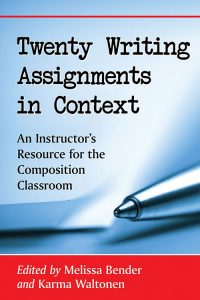
And one of those publications was the textbook I authored with Melissa.

Within the last three years, someone who won the teaching award after me has gotten her raise.

Melissa has gotten a raise for our book.

So this fall, when I turned in my packet, I argued that I should get the union 6%, 3% for the 2015 teaching award, and 3% for the textbook.

About half of the tenured faculty in my department agreed. The other half said I should just get 3% (like Melissa did, which would have negated my teaching award entirely).

One faculty member, the one who said I didn’t deserve merit last time, wrote a red herring argument about how she hated one small piece of my admin work, which went into the file.

So I was worried.

Today, however, I learned that I got my 12%. By one vote.

Share
1 comment

This Recognition Put a Spring in My Step

Teaching

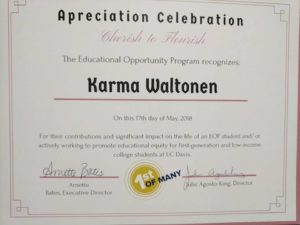
At UC Davis, I do a lot of work with our EOP/STEP programs, for students who are first generation and economically disadvantaged, including giving talks for the program and teaching a specialty developmental writing course.

I do this because I was like them.

I tell them my story and how the most crucial thing I learned was to ask for help.

I show them that people like them can move up in the world through education, even though the climb is so much steeper.

Some years, the program thanks me. This was one of those years.

On the back, a note from the nominator:
“I would have never thought that my favorite class at UC Davis would be Workload 57P. I was able to learn in greater detail the fundamental rules of writing. In this course, I learned more than in my four years of high school English combined. This wouldn’t have been possible without Dr. Karma Waltonen’s amazing work ethic. Dr. Karma Waltonen truly believes in the success of her students and their true potentials. She understood our struggle coming from nontraditional backgrounds, so she made sure to secure a welcoming environment. What I found most helpful and inspirational were the stories of the obstacles she has faced in life. Many of us, if not all, were able to relate to it one way or another, which tore down the wall of silence in the classroom. She made me want to be a better student for her, my parents, my siblings, and the generation to come. The other nice thing about this course was that I was able to see familiar faces from STEP, removing the feeling of loneliness and giving me the opportunity to challenge my writing ability without the fear of being judged based on my appearance.”

Share
0 comments

Paula Poundstone at the PCA Conference

stand-up, Teaching

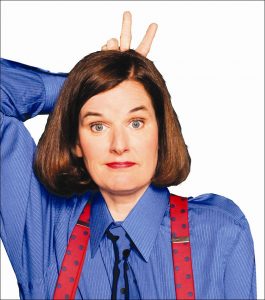
I love Paula Poundstone.
I have always loved Paula Poundstone, and if I ever get the chance to win on Wait, Wait, Don’t Tell Me, her voice will greet you when I don’t pick up the phone.
And I’ll never pick up the phone, just so you can hear her voice.
You’re welcome.
I’ve seen her live several times, and I always include her work on my Stand-Up Class syllabus, because no one does better crowd improv work.
So I was thrilled when she was chosen as our headline speaker at this year’s PCA in Indy. The program said 6:30-8:30, so we gathered on time, only to wait until 7, when a PCA boss came up to introduce her.
The PCA lady told a story about how her husband loves Poundstone SO much and NPR SO much and how he listens to NPR in his car, in their driveway, since the PCA lady apparently won’t shut up.
She then read off a card about how amazing Poundstone was.
But then Poundstone took the stage–and roasted us.
We deserve it. We’re an official association for scholars of popular culture, after all. Our very existence is wonderful in its potential and probable uselessness.
I wish I had sat closer and that she had called on me to talk about what I had presented on–she definitely would have had something to say about “teaching students to tell real news from fake news.”
At 8:30, Poundstone was still going strong, but the PCA lady appeared, right behind Poundstone, scaring her badly.
PCA lady: We need you to stop. The caterers need to leave.
Poundstone: I asked you how long I had, and you said as long as I want.
PCA lady: Well, I didn’t know you would talk all night.
That’s right–the PCA lady, who admitted her husband hides from her because she won’t shut up, was shutting up Poundstone.
And she obviously didn’t know anything about Poundstone, her process, or the glorious way she will go on if you let her.

Share
0 comments

Censoring vs. Censuring

Politics and other nonsense, Teaching

I teach my students about the difference between the words censor and censure–because I want them to know what words mean and because I want them to be able to participate in conversations about the 1st Amendment.

This is especially important with my freshmen, many of whom are Chinese, learning here in a system that throws around “free speech” like everyone knows what it means.

The problem is that most Americans don’t seem to know what it means.*

I was disappointed by Bill Maher’s show last night,** because it seemed that he doesn’t know what it means.

He was furious that people are calling for a boycott of Laura Ingraham’s sponsors after her awful comments about the Parkland protestors.

I understand Maher’s anger–he is sensitive about this topic, since he lost his job–and his show–after a statement he made on Politically Incorrect after 9/11. Many people were calling the attackers “cowards.” Maher disagreed. The attackers were many things, but they were willing to die for their beliefs, which means they didn’t fit the definition of coward.

Maher’s opponents falsely claimed that he praised the attackers.

No–he was making a semantic point. (A correct one.)

Which is why I’m disappointed that he equated calling for a boycott of Ingraham’s sponsors with attacks on “free speech.”

Free speech means the government can’t shut you down, can’t imprison you.

It doesn’t mean you get to say whatever you want without consequences.

It doesn’t mean that you get to have other people pay you to say those things.

Laura Ingraham gets to say whatever she wants. She can blog about it, self-publish about it, yell it to people walking by, mumble it to herself in the insane asylum where she belongs.

But if her speech is no longer profitable, no one has the obligation to pay her to say it.

The old man on the quad who calls women “sluts” when they walk by gets to do that–free speech!

We can call him an asshole–free speech!

But the university doesn’t have to invite him to give a talk, no one has to publish his rantings, and I don’t have to let him follow my students into the classroom, give him “equal time,” or turn the other cheek.

When we disapprove of speech, by saying, “hey, that’s racist,” we’re not censoring anyone–we’re censuring them. Disapproval is not censorship.

My grandparents liked to remind people that my grandfather served to protect free speech–this was of course a form of censure–an attempt to tell liberals they didn’t have the right to speak if the speech didn’t agree with my grandparents’ view of the world.

Like it or not, my grandfather’s job was to fight for my right to criticize his party and to advocate for minorities and for women’s rights.

My job is teaching writing and critical thinking.

Words have meaning. Which is why the 1st Amendment is important in the first place.


*Of course, the 1st Amendment isn’t the only misunderstood one. Ummmm . . . militias . . . ?

** I have to add that Louie Anderson was on the show. And I love him. Desperately.


Share
0 comments

Knowing What the Students Know (And Don’t)

Teaching

How can I tell what my students know?

Melissa and I are at the PCA/ACA 2018 Conference in Indianapolis. We’re talking about activities we do with students, related to our forthcoming book on evaluating sources.

But today I’m pondering: how do evaluate my students in terms of what they’re learning/what they know?

An informal survey I did with my students this quarter revealed that 90% feel that they know how to find scholarly sources on the internet.

However, only 63% of those same students say they know how to tell scholarly sources from nonscholarly ones.

Ummm . . .

Our inability to know what we don’t know is prevalent in college and beyond. It’s difficult, of course, for educators to know how to do our jobs better when so many uncertainties abound.

In my classes, I do a whole day on finding sources. We talk about genre (in an attempt to stop the students from calling articles “journals” and essays “novels”); we talk about the limits of open sources, including Wikipedia; we talk about what peer review is and why it’s important. I show them the subject guides, how to figure out who their librarian is, and how to work the databases.

These skills are tested later, of course. I have them do a basic quiz (find me a book on this topic, find me a peer-reviewed article on this topic), but applied knowledge is required when they do their later research. In upper division classes, I ask my students, as part of getting ready for their term paper, to find a peer-reviewed article on their topic and to write up an evaluation. (Many students tell me it’s their first time reading an academic article in their field.)

Quite a few students have problems finding one, never mind doing the analytical work I’m asking for. They try to do the assignment on magazine articles, on news pieces, on book chapters, and frequently on book reviews.

And this is where I get stuck. When my student thinks a short review of a book on subject x is the same things as a peer-reviewed article on x, what’s gone wrong?

Did the student skip that day in class?

Was the student there but not paying attention?

Was the student just rushing/half-assing the assignment?

Did the student know better but was hoping I wouldn’t notice?

Did I explain something badly, even though most people found the right type of source?

Is there a question I should be asking that I’m not even thinking of here?

I’m tempted to put a little check box on all of my assignments.

How did this assignment go?

  • awesome
  • it could have gone better, but I rushed it
  • I never actually understood what you wanted because you were confusing
  • I never actually understood what you wanted because I didn’t pay attention
  • I never actually understood what you wanted because I don’t care

Because I do care.

Share
0 comments

a problematic post-script

Teaching

Many years ago, when I was teaching at American River College, I had a student who touched my heart. He came from a poor area of Sacramento and was a first generation college student. He needed extra help, due to a mild intellectual disability. He sought that help, and he worked hard. He was sweet and humble. He managed to get a C and asked if he could write extra papers over the break–for no credit–to get stronger. Thus, we worked together for a few months after the course ended.
I used our story in my diversity statement for jobs.
Then, a year later, he asked if he could talk to me. He came to UCD and explained that he had gotten married to a young mother (after a problematically short courtship) and had promised that he would support her and the baby.
He didn’t have a job, but he was pretending to. He was in debt to his uncle, who was actually supporting them. But his young wife was suspicious.
So he asked me to lie for him–to write, on official UCD letterhead, that I was employing him as my assistant. He wanted me to lie if she called.
I couldn’t do that.
I told him he was asking for a band-aid–that the truth would come out–that marriage had to have honesty–that his wife would prefer honesty to a false belief about her husband as a provider. And I told him I couldn’t lie.
I saw his eyes harden against me.
He left quickly, and I never heard from him again.
I wonder if he’s okay, if he’s still married, if he went back to school, if he blames me for not “helping” him. I can’t bring myself to use our feel-good story anymore.

Share
0 comments

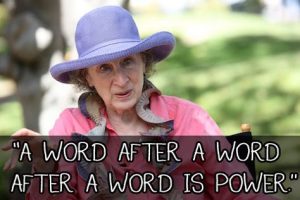
What I Learned in my Atwood Seminar

Politics and other nonsense, Teaching

This quarter, I taught a seminar on Margaret Atwood–we read poetry and short fiction, but focused on The Handmaid’s Tale, Oryx and Crake, Alias Grace, and Hag-Seed. It was a great course, and my students were engaged.

A few observations:

  • the current socio-political climate came up during discussions of each book–they’re frighteningly apropos
  • I had to explain second wave feminism, female genital mutilation, the difference between r and x rated films, and many other fascinating things as they came up in discussion
  • my students think Alias is pronounced uh-lie-us
  • a couple of my students, prior to taking the course, thought “feminist” meant its opposite; when one kept saying the commander was being “so feminist,” we cleared it up

My favorite part of the course was on the last day, when we talked about what, if anything, we’d learned together. One of my students said that what all the texts had in common was a warning to pay attention–to wake up to the world around us and to do something about it.

Thank the universe for Atwood.

Share
0 comments

Close Reading in Kindergarten

Misc–karmic mistakes?, Teaching, Words, words, words

My kindergarten teacher taught us an old rhyme:
Sing a song of sixpence,
A pocket full of rye.
Four and twenty blackbirds,
Baked in a pie.
When the pie was opened
The birds began to sing;
Wasn’t that a dainty dish,
To set before the king?

A Conversation From My Youth:

Me: What does “dainty” mean?
My teacher: Small.
Me: A pie with 24 blackbirds would be really big. Are we saying this wrong? Should we say “undainty”?
[Long pause.]
My teacher: No one else has ever had a problem with this.

Share
2 comments

What “Alike” Gets Wrong About Education

Movies & Television & Theatre, Teaching

When we learned multiplication, one of my classmates discovered he could multiply the top by the bottom OR the bottom by the top and get the same answer.

The teacher made him do his worksheet over.

I watched–and learned–do it her way, or do extra work.

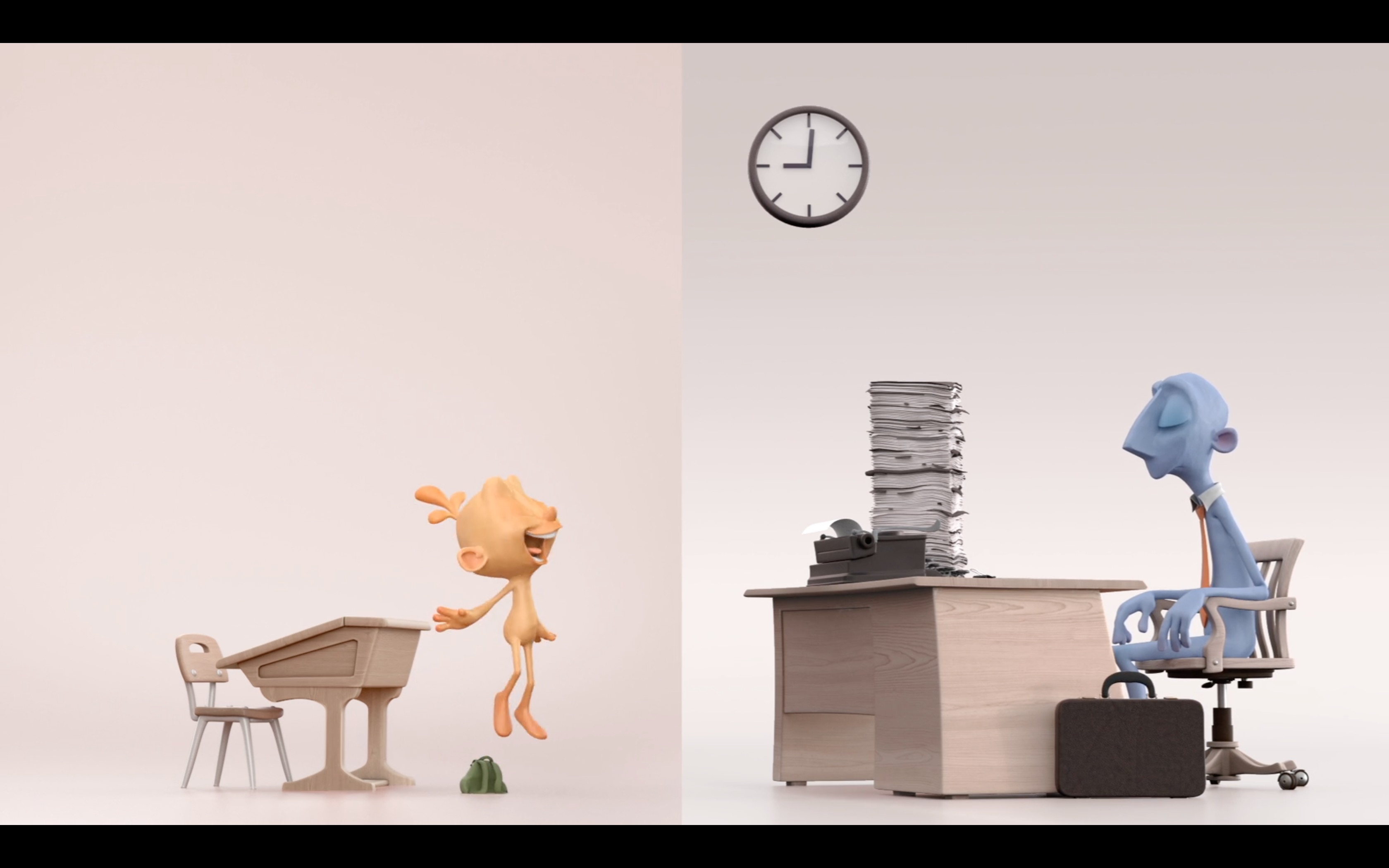
These are the moments that people probably think of when they watch the new Pixar film, Alike. The link I followed made this clear, arguing that the film was touching a cord as it skewers school for making us lose our creativity.

But that’s not what I thought about when I watched this film.

I thought about how I had teachers who fought to teach us science and history in a place (the south) where parents tried to get them fired for doing so.

I thought about my theory of knowledge class–where the very nature of truth and knowledge came under fire–where we were encouraged to debate and to test.

I thought about the encouragement I got from an orchestra teacher when he heard me trying to figure out Flight of the Bumblebee without any sheet music.

I thought about the teacher who circled my cover sheet statement that said 600 words. We had written short stories–the minimum was supposed to be 1000 words. My teacher crossed out her circle after reading the story and wrote “A+ — you couldn’t have added one more word without ruining it!”

I thought about the writing teacher in middle school whose comments were always longer than my papers.

I thought about the teacher who paid out of her own pocket for us all to have our own frog to dissect. Something was coming out of my frog’s abdomen already. I asked what it was and she said, “you’re the best one to figure that out.” (The frog had apparently died of an awful hernia, I discovered.)

I thought about my teachers telling me to learn the rules–before I could break them “prudently.”

I thought about the teachers who forgave me for my chronic lateness–they knew my mom wouldn’t get up to take me to school on time.

I thought about the teachers who listened to me and supported me and encouraged me and basically stood in for the support I didn’t always get at home.

I thought about the teachers who had to deal with us–heartbroken, always–and give advice without reminding us that young love is inherently stupid and dramatic.

I thought about the one teacher who knew I was pregnant the same day I knew (because I told her)–and how she made sure I was always “busy” when it was time to move a piano and who complimented me on the “creative costuming” that let my issue stay hidden until the beginning of the third trimester.

I thought about so many of my university teachers–who managed to open my mind even though I thought I knew how the world worked already.

I thought about the teachers who encouraged me to think.

I thought about the teachers who encouraged me to read.

I thought about the teachers who encouraged me to write.

I thought about the teachers who encouraged me to act.

I thought about the teachers who encouraged me to sing.

Can education, when done poorly, kill your creativity? Yeah.

But I became a teacher because my teachers opened my world. My teachers gave me a future. My teachers saved me.

Everyone who moves on in education can think of a few bad teachers. And a few amazing ones. And that has made all the difference.

And now I’ve become a teacher–because I want not just education that inspires, but a job that inspires me as well.

PS–why isn’t the current critique of this film about the awful work world too?

PPS–even though I think this kid’s artistic side should be nurtured, he does need to learn to write. (Says the writing teacher.)

PPPS–Yes, I’m also the viewer who thinks the English teacher in The Blind Side is not the bad guy!


Share
0 comments