A Covid Shift in My Dreamspace

Teaching

When I first started teaching, I had anxiety dreams. I would show up without my materials, without a plan.

All these years later, I’ve gained confidence. I showed up without my book once; it was fine. Classes have gone off track, productively or not, and I got us back on track.

I’ve improvised an activity for the class to do so I could leave with one student, who was in such crisis she needed to see a mental health professional right that second.

My dreams have to work harder to throw me.

Now, if I have a work anxiety dream, I show up to a class that isn’t mine–in a subject I don’t know–but I’m somehow expected to teach. In the last one, I looked at a board covered in Chinese logograms and turned to the class. “Look, I’m obviously not your teacher.” And then I woke up.

But not all teaching dreams are about anxiety. In many, I’m just doing my job. I’ve woken up having given a whole lecture I had planned to dream students. And then I experience deja vu when I do it for real.

But today, I woke up from a dream of creating modules in Canvas, filling page upon page, converting what I would say to what they would read.

I’d prefer the anxiety dream.

Share
0 comments

Losing Our Museums

Museum Musings

It’s with great sadness that I read NPR’s story about the US potentially losing a third of its museums.

Melissa and I adore museums; even the bad ones, like the ones with misspelled placards, entertain us.

Karlissa often deals with jetlag by heading to a museum to stay awake. We make notes and take pictures and talk about the museum book we want to write. We carry stickies to fix the problematic placards.

We were supposed to go to a Museum Conference this Fall, in fact. Melissa would have talked about her monuments and memorials class, while I was going to wax poetic about being the only American in the American Museum in Bath, England.

There’s a paper–or something–I want to write about Museums in popular culture and literature, from the way they’re lovingly derided in The Simpsons (“Hey, kids, I’ve learned that in two weeks the Springfield Museum of Natural History will be closing forever due to a lack of interest. I urge you to see it while you can!”) to their complex portrayals in apocalyptic literature like Children of Men and Station Eleven.

What’s striking to me know, though, is a political irony. Though our museums only get about a quarter of their funding from the government, Conservatives often have museums on their defunding lists. With their current hold on the Senate and the Presidency, it’s unlikely museums will get the help they need.

The irony comes from the newfound hysterical cries from the right to preserve history.

They’re talking about statues, whose didactic power is narrow.

If we truly want to preserve history and to learn from it, we need our museums.

Share
0 comments

Whatever’s comfortable

Misc–karmic mistakes?

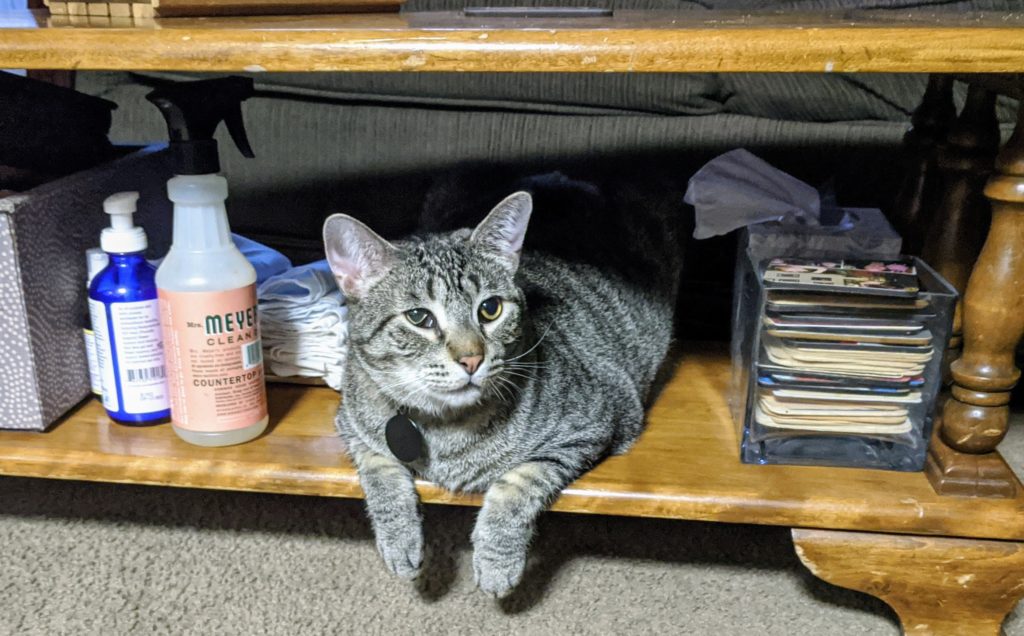
Today is the second anniversary of adopting Graymalkin and Thoth. It’s also the second anniversary of finding out Graymalkin is blind.

He’s remarkable at adapting, so it’s hard to tell, unless you live with him long enough to see him run right into walls when he gets turned around or when you hold a toy right in front of his face and he can’t see it.

We’re not sure what caused the problem, but my medical team has theories. One of his eyeballs appears smaller than it should be, while the other is bigger. The thinking is that something happened in the womb–his little head got smushed, pushing one eyeball forward and the other back, enough to take away almost all of his sight.

What makes this fascinating, though, is that he looooooooves to have his face smushed.

Whenever he wants a nap on me, he circles my chest, unhappily, until I take his face into my hand and hold it tight. Then, he sleeps peacefully, until I need my hand for something.

Since we’re not always available to smush his face, he has discovered a spot in the living room that allows him to do with a pillow.

This is where he sleeps.

Does he snore?

Of course.

Share
0 comments

#BestMuseumBum

Museum Musings, Simpsonology

If you head on over to Twitter and scroll through #BestMuseumBums, you’ll see museums around the world competing, cheekily, for having the best butt in their collection.

Here’s the best bum in the Waltonen collection. It belongs to Princess Cashmire.

Share
0 comments

When They Don’t Answer

Teaching

Teaching online has been eventful, which is ironic, since it doesn’t look that way. Watching me teach now is seeing me sitting at my computer, typing. It’s only when you might catch a glimpse of me with a medieval jester puppet as I make a video that an “event” is evident.

There were struggles when I had to teach my first fully online courses at Davis and when I had to convert my Los Rios semester classes to online mid term.

Right now, I’m teaching my first fully online Los Rios course.

I’m better prepared, both through the few months of experience I have and through the course I took for certification to teach online.

I’m grappling with a problem I assume is common. Many of my community college students aren’t doing any of the readings or watching any of the videos. They’re just going to assignments.

And then they fail the assignments because they didn’t do the reading.

The Davis students last term learned their lesson quickly. They either started doing at least some of the reading or they dropped.

My current students aren’t learning that lesson quickly. I can post announcements and videos and write comments on their assignments all day long, but if they aren’t doing the readings/viewings, then they aren’t seeing those corrections.

In class, I could pull them aside. I could make an announcement to the whole class that they would at least be in the room for.

I’ve managed to find ways to pull most of them aside, virtually.

Except one student.

She added the class with a PTA the second day. And I honestly don’t think she’s read anything.

Not the syllabus or schedule. Not the announcements. Not my comments to her. Not the textbook.

She’s failing, not surprisingly.

Over a week ago, she wrote on an assignment that she was confused because the dates kept changing.

I haven’t changed a single date.

The schedule I give the students is complete at the very start of class.

And we stick to it.

It takes an emergency–and not just a personal one. The only time I’ve changed due dates in recent memory was when school closed because of the fires.

So I wrote her a note back, telling her that I wanted to figure out where the confusion was so we could get her on track.

And then I remembered that she didn’t read my comments on her submissions. So I sent her an email through Canvas and an email the regular way.

No response.

She didn’t disappear, though. She keeps turning in failing assignments.

It’s been a week. She’s gotten a second email (I know she uses her email–she emailed me twice at the start of term) and a phone call.

Yes. A phone call. (Their numbers are on the roster in the Los Rios system.)

She didn’t pick up, but I left a message that I wanted to get in touch because I wanted to help her figure out the assignments and the dates.

No response.

I don’t know what to do now.

If this were a movie, I would find a way to find her, neglect my family and my other students, and babysit her little sister, while helping her complete her assignments.

This movie idea–that we should all reach every student all the time–is damaging and pervasive.

At every conference, it’s reiterated that if our students can’t pass our classes, it’s because we’re doing something wrong.

This is an excellent example of how that’s not true.

But I still want to help her.

And she’s not going to let me.

Share
1 comment

The Healing of America, by TR Reid

Teaching

As I’ve mentioned before, I do extra credit book clubs with my students.

After one book club, one of my students recommended The Healing of America, so I made it our book for the next quarter.

Reid lays out the problems with American healthcare, which is fundamentally about our paradox. We spend more than anyone else, but we’re definitely not healthier. And not all of us have access to care. We let people die of manageable diseases.

Reid takes his own imperfect body around the world to look at how other developed nations handle care.

Along the way, he addresses common American misconceptions about the rest of the world, about too-long wait times, rationed care, etc.

I was surprised when my 104F students told me that Reid’s book surprised them. They had believed all those myths.

I guess I shouldn’t be surprised. I didn’t know much about how the rest of the world worked when I was their age, but I thought they might know more about their field–and how fucked up it is.

One smart, tightly-wound student managed to shock me, though. After the other students talked about how they would definitely want to work in systems where insurance companies couldn’t override doctors, etc., one student said she was against affordable healthcare.

“If anyone can come to my office–if it’s not expensive to see me–then they won’t respect my degree and how much work I’ve done.”

Another student pushed back.

“So you would rather work in a system where someone could die because they couldn’t afford treatment?”

“Yes.”

Share
0 comments

Online Dating 96: P Returns

dating

Many years ago, I wrote a post about a guy who scared me off poly dating, P.

He pressured me into defining myself as poly (in his terms) and delimiting my dating choices very quickly into the relationship.

In Iceland, Melissa and I talked about it, and I knew I had to break up with him.

He had been wanting to come over when I got home, and I knew I wouldn’t be able to handle that.

Part of the problem of our relationship was the endless nagging and pressure, and I know I couldn’t cope with breaking up with him in person at my house after about twenty-four hours of travel, since that would also be an invitation for nagging and pressure.

And so I called him on a layover to tell him not to come.

(I apologized for doing it over the phone, multiple times.)

He has gotten in touch a couple of times over the years, and I’ve told him I’m not interested in resuming a relationship.

He got in touch with me again this week.

He says it’s not because he wants to date me, but because he misses me. I reminded him that we dated for a few weeks half a decade ago, that we were never intertwined in each other’s lives, and that I hadn’t enjoyed most of the few weeks we had spent together, so I didn’t miss us.

His attempt at reconnection did give me an opportunity to check something, though.

Whenever there’s a breakup, a relationship, a conversation, the two people remember it differently.

We construct a narrative that we think is true.

So I asked him what his narrative about our breakup was.

He said that he’d misinterpreted my asking for space to mean not to contact me much when I was in Iceland, and that I’d broken it off because we didn’t talk much that week.

He said that’s what I implied when I called him from the airport.

I remember mentioning us not talking much that week, but it was toward the latter middle of the call. And that’s not at all why I broke it off.

In my memory, during the layover call, he was trying to convince me to still let him come over. He said that we had to decide, as a couple, that a breakup was the thing to do. And I said breakups could be unilateral decisions.

He said he also wanted to talk to me because he’d taken a job in Reno, and we needed to figure out how to maintain our relationship, like maybe I would go to Reno one or two nights a week.

The Reno thing made me feel even better about my decision. There was no way in hell I was going to drive to Reno all the time.

A reference to not talking much while I was in Iceland came up here, as I pointed out that we obviously weren’t in the kind of heavy duty relationship he kept insisting we were in if he could take a job in Reno without mentioning it to me for days and days.

None of this really matters now, of course, but I wonder what narratives I have that are wrong.

(Can any of them be wrong, fellow postmodernists, when there is no truth?)

In a breakup a few years ago, I witnessed the construction of an alternate narrative. I was trying to explain to someone that I wasn’t happy, that I hadn’t been for a while.

“At first, I thought it was because I’m working so hard, but then I realized it was the relationship that isn’t working for me.”

“Of course,” he said. “You have been working hard. And I can see why it would be hard to be in a relationship with you working so much.”

And I just shut up.

He didn’t ask me what about the relationship didn’t work.

He had his narrative.

And I had mine.

Share
0 comments

S Town

Movies & Television & Theatre

I tried listening to S Town this week. I wasn’t captivated.

There was nothing wrong with the storytelling.

It took me a while before I figured out what was wrong.

I’m from a place like that.

S Town, for “Shit Town,” is Woodstock, AL, which is four hours north of where my stepfather lives (and where I did K-12). It’s four and a half hours north of my ancestral home, which we call Pinelog, as it’s surrounded by Pinelog State Forest and Pinelog Creek. Pinelog’s not a town–we have to use the post office in the closest town, Ebro (famous only for its dog track), even though they’re technically in another county.

When I heard the subject of S Town speak, I thought, yup. Sounds like a bunch of my cousins.

The subject’s home is hard to find. So’s the one I grew up in. Google maps can’t see it through the tree cover. It blends in with the rest of the forest, the rest of the swamp.

One of S Town’s main industries is logging. Same for where I’m from.

S Town, in other words, was very familiar. Too familiar.

And that’s why I couldn’t get into it.

The producer is astounded to hear people openly using racial and homophobic slurs, when they know they’re being recorded. I’m sure most of the audience is too.

And all I could think was yeah, that’s part of why I left.

It’s exotic to the NPR audience; it’s not at all exotic to me.

Still, if you ever wonder what my accent might have been, give S Town a listen.

The creek (correct pronunciation: crick)
Just outside the back of the house.
Share
0 comments

Evaluating Fake ADA Cards

Who’s Your Source

Apparently, some of the people who refuse to wear masks during the pandemic are carrying cards around, which threaten businesses if they refuse to serve the mask-less person.

The card claims that the person holding it has a disability and thus doesn’t have to wear a mask.

Those of us who are disabled (and those of us with critical thinking skills) know that’s not how disability accommodations work.

If someone really couldn’t wear a mask, the accommodation wouldn’t be to simply let them in; it would be to make sure they can still access the goods. Thus, they might give their shopping list to an employee and have them brought out.

My students who need accommodations don’t get to just skip the exams; we figure out a way for them to take it with modifications.

However, you don’t need to know ANY of this to know that this card is bunk.

Some of this information is true. That is the ADA number, and the ADA does have guidelines and penalties.

However, this card is a lie.

The DOJ symbol is not authorized; this card is not government-approved.

The person who would show this is hoping you won’t look closely.

If you did, you might notice that the word “poses” is spelled incorrectly, and that government agencies don’t end in “.com.”

What is FTBA, anyway?

It’s the “Freedom to Breathe Agency.” I went to their website, so you don’t have to. There’s almost no information, just a picture of two kids enjoying the sunshine and some vague claims about freedom and America. It’s not clear at all that it’s about flouting pandemic policies.

But that’s what it’s about, and it’s counting on its visitors knowing that.

They’re not good at clarity, not good at spelling, not good at logic, not good at science, and not good at empathy.

But they’re a great example of why evaluating sources is essential!

Share
0 comments

The Too-Much Ethos Problem: An Example

Who’s Your Source

I was catching up on my Colbert this afternoon, wanting especially to see the interview with Jon Stewart. They talked about the election, the virus, and our overdue reckoning with institutional racism.

As part of the latter, they drew attention to how two white guys were talking about racism, and how some white people can only hear about racism from other white people.

Jon mentioned that he, Jessica Williams, and Jordan Klepper had a bit in which Jessica would talk about racism, Jordan would shut her down, Jon would restate Jessica’s point, and then Jordan would agree.

The best Daily Show with Jon Stewart video that does this is “Helper Whitey,” a discussion about the confederate flag. (ooooh, timely too)

Karlissa actually tackles this ridiculousness in our new book. When discussing ethos, we should remember that some people, those not inclined to agree with you, will dismiss you for having too much ethos. Too many whites don’t believe black accounts of racism. Too many men don’t believe women’s accounts of sexism.

And that’s why we all have to speak out. I’ve seen white students’ resistance fade a bit when I talk about white privilege, just like I’ve seen some men’s shoulders go down when another man embraces feminism.

This shouldn’t be how it is.

But it is.

Speak up; speak out; speak loud.

Share
0 comments