Museums in the Pandemic

Museum Musings

To celebrate International Museum Day, take a look at some of the amazing museums you can virtually explore.

We assume you know about The British Museum, the Guggenheim, the Louvre, The Smithsonian, The Met, and other famous ones, but check out these lesser known ones:

The Jim Crow Museum

The Museum of Broken Relationships

The Picasso Museum

The Dali Theatre-Museum

The National Women’s History Museum

The Mutter Museum of Medical Oddities

The International Museum of Toilets

The Museum of Bad Art

The Icelandic Phallological Museum

Google has an extensive list of virtual tours.

Museums around the world have been competing about who has the creepiest objects on Twitter (#CreepiestObject). You can read about it here.

Some museums are letting penguins in, so you can see art AND PENGUINS!

You can also watch gerbils behaving badly in their personalized museum.

Happy International Museum Day!

Share
0 comments

What I’m Afraid Of

Politics and other nonsense

No one wants the economy to fail. No one wants to stay under lockdown forever.

I really hate strawman fallacies, especially when it’s my point of view being painted as anti-American.

That’s why I try to empathize with those on the other side. Those who want to reopen everything are varied. Some think the disease is a hoax. Some equate following safety protocols with being a democrat–and they hate democrats. Some believe that this is a massive government power grab. Some go further, believing this is a demonic conspiracy to force a one-world government. Some believe the government can’t ever tell them what to do. Some think we need to establish herd immunity by getting infected (in this plan, the “weak” are sacrificed for the strong). Some are just focused on the economy–at micro and macro levels.

Those of us who want to follow the science on when to reopen aren’t ignoring the economy. We’re angry about how the stimulus money was used, with almost all of the benefits going to the rich. But reopening now won’t fix the economy; it will further hurt the middle and lower class. If your restaurant is open but not enough people are coming, you have no access to emergency help. Your immuno-compromised staff members have to come to work or starve; no unemployment help will be given.

The current administration’s plan is to suspend aid to us and to take away the ACA. There’s no future where we won’t have a recession, but there are ways to mitigate it.

Rich people and corporations pay lower tax rates than I do. How about evening that out? How about not allowing stimulus money to go to corporations and businesses that don’t pay American taxes? How about making sure everyone has access to healthcare? How about a work program? How about making sure whatever stimulus packages we pass actually go to the people who need it? We’re the richest and most powerful nation in the world. Our citizens should not be starving or dying because of our backward belief that the poor and unemployed just made bad choices but that Fortune 500 companies deserve our tax dollars.

We all want to reopen as soon as it’s safe. Fellow citizens, your actions make it harder to believe we’ll be safe. Stop marching with guns. Stop threatening to kill the rest of us. Stop attacking health care workers and store employees. Don’t spit on people or yell at people wearing masks.

If you would put your damn mask on to go shopping, maybe we would agree with you that people should be able to “make a choice” about what stores to go to.

Your choices affect all of us. Show us you could make the right ones.

The reason the current administration doesn’t wear masks is because they and their staff are tested every day. Demand testing.

Fox News says we should return to normal, but it’s ordering its staff to follow social distancing guidelines.

Don’t we all deserve to be just as safe as someone who works at Fox?

Support more testing, support tracking, support aid to workers and families, support PPE, support social distancing.

Maybe some of you do, but that’s not what I’m seeing at your rallies or in your posts.

I’m seeing a false choice–that either we stay inside forever or we all do whatever the fuck we want cause you have guns and some flags, many of which aren’t even American flags.

The middle ground is that we invest a lot in safety, and then we go outside. Can we do that?

I have family members who think the government is overreaching. The government overreaches a lot, but I’m not worried about these lockdown orders or about the hidden conspiracies.

I’m worried about the right-out-there-in-the-open conspiracies.

Like when Trump asks why blue states should get aid.

Or when he touts a dangerous drug because it’s personally profitable for him and his friends.

Or when he says people should stay at home, unless the governor is a democrat, and then he supports armed insurrection.

Or when he says we don’t need testing or tracking.

Or when he says we shouldn’t vote online.

Or when his son-in-law says the election might not happen in November.

Just like you, I really wish my greatest fear was the virus right now.

Share
0 comments

The Truth About Letters of Rec, Part 3: Mistakes

Teaching

Now that we’ve discussed the basics and how to get mentors, let’s talk about the mistakes students make:

Thinking that getting a good grade is enough.

Just because you got a good grade in my class doesn’t mean I like you. Assholes can do well on tests and essays. I’m not going to recommend that asshole, dooming the next person to being stuck with them for a while.

Conversely, I’ve had some students who didn’t get the highest grades get great letters–because I saw how much they worked, because we got to know each other.

Remember, too, that I’m not supposed to tell anyone your grade in the letter, so if I all know about you is that you got an A, but I have no further information to give, your letter will be a form letter.

Asking someone who can’t recommend you.

My friend Vanessa had a student ask her for a letter of recommendation after she caught him plagiarizing. He thought that because she hadn’t been mean to him in class–because she was a professional–that his transgression had been completely forgiven and forgotten (besides being sent to SJA).

Vanessa’s thought: but why in hell would I recommend a cheater?

I had a student ask me for a letter after failing my class. The student and I were friendly enough–she was failing because she wasn’t actually ready to be writing at the upper division writing level yet.

I was surprised when she asked me for a letter–while I could write about how generally cheerful she was, I didn’t have anything nice to say about her academic potential.

(I declined.)

The silliest example, though, comes from a total fuck up in my class. He was failing–his papers were awful, when he got around to turning them in, he failed all the reading quizzes, didn’t do the homework, and on the day he came to my office for a letter, he hadn’t been prepared for his class presentation.

He was floored when I said I couldn’t recommend him for our Washington program.

“I can’t recommend you.”

“What do you mean?”

“I mean, based on my experience, you’re a terrible student. So I can’t tell other people that you’re a good one.”

“I don’t understand.”

“If every time I ate at a restaurant, I got food poisoning, I would not recommend the restaurant to others. I can’t tell people that they want to work with you, based on my experience with you. Don’t you have a class in which you’re doing better? A teacher you have a better relationship with?”

“No.”

“Why did you ask me?”

“My roommate said to ask my English teacher because they write good.”

I didn’t correct his misapprehension that I was his “English” teacher, but I did get really snotty.

“I could write poetry about how you don’t do your work in my class. It would be beautiful. Is that what you want?”

Asking impolitely.

Don’t assume we owe you one. You are asking us for a favor.

Don’t ask over email, unless there’s no other way. For example, during this shut-down, I’ve had some email requests come in, but the students have been smart enough to apologize for having to ask me this way. Even then, it’s not enough to send a one-sentence email. You need to explain why, when, where, etc.

Don’t ask at the last minute. We expect at least a month’s notice.

There are exceptions, of course. Maybe you just discovered a scholarship or your other recommender died (I had to step in in a case like that.)

But you should know when your grad school application is due. Not asking for the letters until the week they’re due illustrates that you are not good at planning or time management and that you don’t respect our time. You’re not the only person wanting a letter–and they all tend to be due around the same time. If I know I have several due in the same week, I can make plans to get them done, but I don’t have the time or the will to add yours to the big pile if you ask late.

Being an annoying person.

This is different from being an asshole. And there are many ways to be annoying. Were you the student who, after your teacher said to the whole class that he couldn’t talk after class because he had to get across campus for another class, came up to him after every single class and said, “I know you gotta go, but . . .?”

Are you the student who argued about every little grade?

Are you the student who couldn’t seem to do any assignment on her own or who never read the syllabus before asking a question?

Are you the student who was always on his phone?

Are you the student who won’t take “no” for an answer about a letter?

Last year, a student emailed me for a letter request a week before the letter was due. We had never spoken. I told her I couldn’t write the letter, because I didn’t know her.

“Well, could we spend a few hours together this week then?”

Ummm . . . FUCK NO!

Not signing the privacy waiver.

Schools and programs ask you to sign a privacy waiver, meaning you won’t read the letter we write. The schools and jobs and programs want us to be honest.

If you don’t sign the privacy waiver, it’s a red flag.

Are you saying you don’t trust your letter writers? Your mentors? Why? What do they know about you?

Are you paranoid?

Are your letter writers afraid of you? Are they tired of you bugging them and so they’re just writing something to make you go away?


Share
1 comment

There’s Something About “There’s Something About Marrying”

Simpsonology

This week, my Simpsons class and I are doing our unit on sex and sexuality, using my chapter in my and Du’s new book, The Simpsons’ Beloved Springfield.

One of the episodes I like to use is 2005’s “There’s Something About Marrying.”

The same-sex marriage debate comes to Springfield, dividing, briefly the Simpsons’ household, as Marge lobbies Reverend Lovejoy to be more accepting, and Homer protests legalization. (When Homer realizes he can profit from officiating gay weddings, he changes his position.)

Patty soon announces she’s marrying a professional female golfer. Marge has been in denial about her sister’s sexuality, which is moderately understandable, since Patty almost married Seymour Skinner once. Marge’s liberal positions don’t hold true when she’s asked to accept her sister.

Marge comes around, of course–she does love her sister.

But Patty doesn’t get married. Marge has discovered that the other bride-to-be is actually a groom. He is posing as a female not because it aligns with his gender, but to be a female golfer. He and Patty hadn’t yet had sex, and he wasn’t going to tell Patty until after the wedding.

When he asks Patty to accept him as a man, she declines: “Hell, no! I like girls!”

The last time I taught this episode, two years ago, some of the students’ responses surprised me.

Many of them conflated the golfer’s fraud with being transgender, even though the show clearly indicates that’s not the case. And some argued that Patty should have married him, that if she loved the person, she shouldn’t care what kind of body he was in.

While I could understand this came from a good place, a place of more fluid gender boundaries, I had to push back.

He lied to her, after all. And he planned to lie to her until after they were legally bound together. “What was going to happen,” I asked, “on their wedding night when she learned she’d been deceived in such a way?”

Lying aside, I also tried to explain that Patty might just not be sexually attracted to men. And that we shouldn’t judge her for not also liking men.

In twenty years of teaching this show, I’ve gone from pushing against students’ homophobia against John in “Homer’s Phobia” to insisting that Patty’s lesbianism doesn’t have to turn into full-on pansexuality.

Who would have thought, all those years ago, that a lesbian character would come off as too sexually conservative? And what will push my students’ children’s buttons in the years to come?

Homer marrying Patty and her "wife."
Share
1 comment

The Eerie Timelessness of “Much Apu About Nothing”

Simpsonology

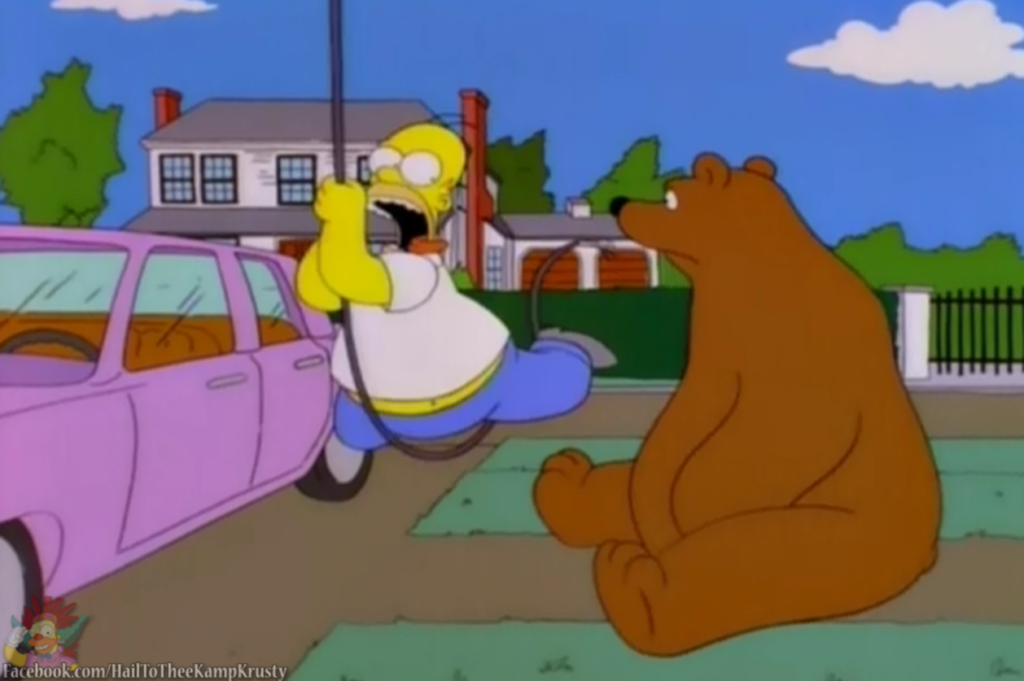
This week, my Simpsons class is tackling politics. Last night, the boy and I sat down to rewatch “Much Apu About Nothing.” While other political episodes rotate on and off the syllabus, “Much Apu” is always there, for the way it captures corruption, mob mentality, red herring issues, and more.

Since the episode starts with a bear, the boy said it was perfect for this week (there’s a lost baby bear in Davis, causing a stir).

But the more we kept watching, the more we realized this episode fits amazingly well with the current covid zeitgeist.

Right after being advised to stay in his home, Homer breaks quarantine.

He was trying to drop gracefully through the windshield.

The next thing you know, there’s an angry mob marching to their city hall in protest.

They’re much better behaved than the current protestors, though.

When confronted with a problem, the town turns immediately to xenophobia.

Rather than follow any logical advice, the townspeople rely on weird fixes for their problems, using specious reasoning.

At least they’re not injecting themselves with bleach.

Share
0 comments

UCAFT Online Picket

Teaching

Yesterday, I added my story to our online picket page.

The University of California said, when this crisis started, that our jobs were safe until 6/30.

That’s when our yearly contracts are up.

We’re worried they’ll use this crisis to get rid of people with experience and replace them with brand new teachers who cost less.

And so we’re standing together today (and every day) to explain what a 6/30 layoff would mean.

For those of you outside of academia, know that someone who is laid off in the Summer will NOT be able to get hired to teach somewhere else in Fall. Our job searches take months–almost a year for the good ones. A tenure-track job starting in Fall 2020 had its call go out in October of 2019. The positions are filled.

And yes, we’re still working out of contract.

One of the biggest frustrations for me is how the university’s understanding of my job is so different from reality.

The university says I’m not teaching online, that I’m doing remote instruction (meaning fully synchronous courses).

My students would be surprised by that, since we’re asynchronous.

(We’re supposed to get paid more if we’re teaching online, which is why this semantic argument matters.)

The university says we don’t write letters of recommendation.

Just this week, I’ve been asked for four more.

The university says we don’t mentor.

Just this week, I’ve gotten eight emails thanking me for checking in on students. They say their professors are “less personal” with learning.

Just this week, I’ve gotten three emails from students of years past, telling me they’re thinking of me, that they’re grateful for me, that they’re wishing me health in this uncertain time.

Just this week, I’ve gotten four emails letting me know about the final graduate school choice I helped my mentees make.

Just this week, I’ve gotten confirmation that I’ve helped a student whose dissertation committee I was on get a tenure-track job.

Just this week, I’ve been asked to be the opener for the stand-up club’s Zoom show they’ve organized.

I’m used to the university insisting that my research doesn’t count, since I’m teaching faculty.

But damn if I don’t want them to fucking recognize the great teaching we do.

Share
0 comments

C’mon!

Chronic Pain

It’s extremely difficult for me to stay in any semblance of “shape.”

I’m already overweight, and I’m my 40s.

I’m disabled.

Right now, I can’t go to PT, to the chiropractor, to the massage therapist.

I’m not getting my bursitis treatment or the injections into my herniated disc that I need.

But I’m trying.

I keep going on walks–to be healthy, to maintain (if not lose) weight, to lower blood pressure.

I can only do it in the mornings because of the heat, which means giving up some of my most productive writing time. But I’m still going out.

It’s Spring, and I’m allergic to trees, grass, weeds, etc. But I’m still going out.

Today, my sacrum is locked. My hernia is pressing on my sciatic nerve, my bursitis is flaring, my knee freaks out when I pivot left (the other one is going numb for some reason), my ankles keep turning.

But I still went out.

And just as I was getting to the inevitable point when my walk becomes a pathetic hobble, a neighbor pulled up in a car to tell me to go inside.

“There’s a bear somewhere around here!”

C’mon, universe!

Share
0 comments

The Truth About Letters of Rec: Part 2: Finding Mentors

Teaching, Words, words, words

If you want a good letter of recommendation, you need to get to know us.

As I mentioned in the last post, this shows you can build the mentoring relationships you’ll need to be successful.

How do you start?

Come to office hours.

I don’t count talking to me right after (or before) class–I’m trying to get the room ready for the next person, and then I have to head to my next appointment or class. You do not have my full attention, and I might be annoyed with you but not showing it.

If you don’t come to office hours, though, I’ll just be grading papers. I could be talking to you, which I generally like doing a lot more.

Not sure how to start? Ask us about ourselves! Everyone’s a bit of a narcissist. Ask how we decided on the right graduate program, how we balanced academics with extracurriculars, etc. The person you’re talking to should turn those questions back to you–and then you’re learning about each other.

Seek additional work or knowledge.

One of my favorite students talked to me a lot; I recommended a book for him as our course ended. I didn’t expect to see him again, since most students disappear. But he read the book over break and came back to office hours to talk about it.

We built a great relationship over the four years he was at Davis, and he ended up with one of my very best letters.

Many years ago, I had the supervisor of engineering at Genentech come to my class. This happened during the Q&A:

Student: How do you know when you want to give someone a promotion?

Supervisor: Okay. You come to work on time every day and do a great job. Am I going to promote you?

Student: Yes!

Supervisor: Um, no. That’s how you keep your job. If you want me to notice you, do something worth noticing. I promote the people who want to get better at their job, the people who are curious. The person who comes to me and says, “hey, there’s only one guy who is trained to calibrate that machine, but it often breaks when he’s not here. Can I learn how to do it?” is going to get noticed.

Talk to us about independent studies. Ask for further ideas–books to read, podcasts to listen to.

One important note: there are definitely students who go to office hours too much. They seem unable to read instructions or to work without someone looking over their shoulder. They get huffy when we point out they’ve been talking to us about every word of their essay for an hour while there’s a line of ten other students out the door.

This is not impressive. And we know that behavior will not be rewarded in graduate school or the work force, so we won’t be able to recommend you.

If you’re looking for actual mentors, you may need to do the following:

See us outside of office hours.

Not everyone who writes a letter for you will also be a mentor; mentoring is the next level. A mentor should:

  • be interested in more than just your letter
  • be willing to give you advice and guidance
  • be able to give you a helpful kick in the ass when you need it
  • be knowledgeable enough about you to know what you most need to hear when you’re stressed, to offer opportunities that you need, etc.

Lots of students get letters from me every year.

Not every student has me forward job opportunities to them.

Not every student has me help them with their letters and scholarship applications.

Not every student gets invited to a meal with a visiting author because I happen to know that’s their favorite author in the whole wide world.

Not every student gets taken to a Comic Con as my assistant so I can introduce them to publishing contacts for their art career.

Not every student maintains a relationship well into graduate school, with me helping them on that first super challenging assignment.

Those relationships take time and effort, and it’s up to you to start them.

Harry Potter readers know that in the British system, students have to wait for teachers to notice them and hope they’ll be chosen to come up for a butterbeer.

In America, you have to come to us. At UCD, they even have a fund you can use. If you want to have a pizza with me and your small group as we go over your grant application, you can apply for that pizza money. If you want to have coffee with me at the Coho so we can talk without twenty students waiting outside my door, you can apply for that coffee money to treat me as a thank you.

Remember, you don’t want the form letter that someone hasn’t even proofread:

I write to recommend John Doe for your graduate program. John was a student in my Advanced Composition course three years ago. . . . Jane is hardworking and intelligent.

You want us to be able to talk about you, to fight for you:

I give my highest possible recommendation for John Doe. John has taken two advanced writing courses from me in the last two years. He has also served as my intern on x, doing y. . . . John’s work in securing a grant for patients in the z clinic will benefit their lives for many years. . . . You want John in your program; out of all of my Health Science Writing students, he is the one I would want as my physician in the future.

http://studentaffairs.ucdavis.edu/students/dean-witter/
Share
4 comments

The Truth About Letters Rec: Part 1: The Basics

Teaching, Words, words, words

In some of my classes, like the health science writing class, we practice writing statements of purpose for grad school. In one class, I mentioned that they needed to make sure the letters of recommendation were also strong.

Questions and answers about that filled the rest of the period. The students gave me feedback that the detour we took was exceptionally helpful.

In my classes now, I set aside a day they’re turning in a paper to have this talk.

And now I’m reproducing it here.

The Basics

There are several types of letters:

  • Bad
  • Meh
  • Good
  • Great!

I won’t write a bad letter. And I don’t know anyone who relishes doing so. But sometimes a student hounds a teacher after several polite refusals, and the teacher says: Fine. I will tell that school EXACTLY what I think of you.

Meh letters are form letters. They say you’re smart and hardworking, like everyone going to grad school should be. There are no details about you. Everyone reading it knows it’s a form letter. It doesn’t help you.

Good letters make it seem like we actually know you and that we actually recommend you. They talk about you.

Every once in a while, we write a great letter. We go beyond praising you. We make it clear that they’re idiots if they don’t want you, because everyone should want you. These are rare. They are saved for those we’re close to, for those whom we know have struggled, for those who are truly exceptional.

WHAT THEY DON’T ASK:

  • What was the student’s grade in the class?
  • Was s/he/they on time to class?
  • Did s/he/they come to all (or most) classes?
  • Did s/he/they complete the work?

First, your grade is on the transcript. Second, they assume that if we’re recommending you, you did the minimum.

Note: if you brag on your statement or resume about being on time, that’s a red flag. It’s not a skill. It doesn’t make you special. If you think it’s worth mentioning, we know you have a very low bar for yourself.

It’s like saying, “I always showed up to class dressed!”

WHAT DO THE SCHOOLS WANT TO KNOW?

They want to know what kind of person you are, whether we enjoyed working with you, whether they might enjoy working with you. This is about your strengths and weaknesses and personality.

First, they ask us:

  • How long have you known the student?
  • In what capacity have you known the student?
  • How well do you know the student?

If I click “not very well,” I’ve just killed this recommendation. I’m admitting that I have no ethos (credibility) here.

If your recommenders say they don’t know you, there are two possible red flags.

  1. Maybe you didn’t ask someone who actually knows you, because people who know you learn you’re a selfish asshole.
  2. Maybe you never got to know any of us, which means you won’t succeed in graduate school. You can’t hide in the back of a room in a six-person class. If you can’t talk to us, how will you put your committee together? How will you find your mentors? If you can’t find two people in undergrad who can check “fairly well,” then grad school is not for you.

Second, they ask us to rank you. Often it’s this:

Rank the student against all the students you’ve taught:

  • Top 1%
  • Top 5%
  • Top 10%
  • Top 20 %
  • Not in the top 20%

The next bubble sheet:

Rate the student in terms of:

  • leadership
  • oral communication
  • written communication
  • ability to work in a group
  • problem solving
  • ethics
  • ability to work independently
  • responsibility
  • creativity
  • interpersonal skills
  • research ability
  • intelligence
  • critical thinking

Yes, every teacher, not just your writing teacher, is asked whether you can write well.

THE BOTTOM LINE:

We need to know you.

The next post will talk about how to make that happen.

Share
7 comments

What’s Your Creepiest Exhibit?

Museum Musings

We’re loving that museums around the world are competing to see who has the creepiest exhibit and that The Bloggess has joined in the fun.

I just asked the boy what we had lying around.

“You mean besides the puppet?”

Even when he’s trying to be nice, he’s creepy.

To be honest, the creepiest things in this house are the dead, dismembered lizards I haven’t found yet.

But they’re here. Somewhere. More lizards get brought in than corpses I’ve found.

My place is more of a pop culture/Simpsons museum than a creepy one.

But that’s why I go to museums.

Some are inherently creepy:

Others just have creepy things on display.

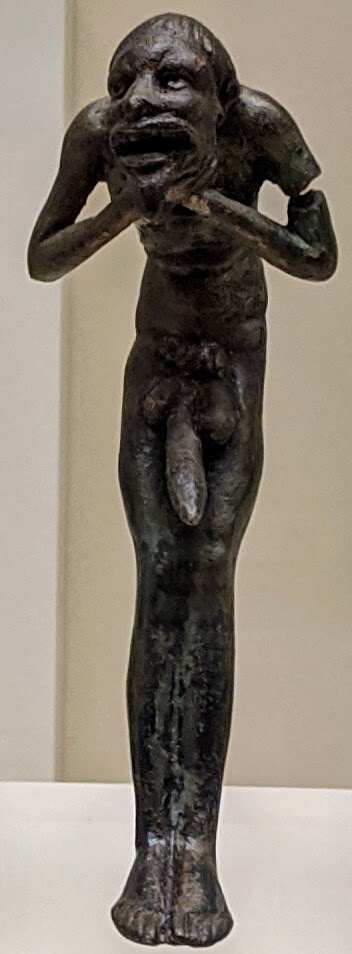
like this guy
or this personification of tuberculosis
I mean, what the fuck?
Does TB make your genitals huge?
Is the problem that he’s too sick to fuck?
Nevermind, I guess he’s more confusing than creepy.

We can’t wait for restrictions to be lifted so we can get back into museums, but we’re excited that so many are offering virtual tours in this time of crisis.

Share
0 comments