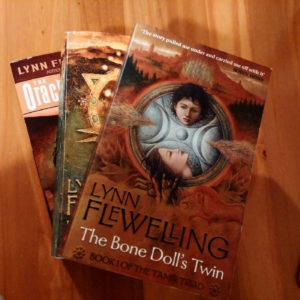
Karma Reads: The Tamir Triad by Lynn Flewelling

Words, words, words

All I knew about The Bone Doll’s Twin, the first book in the Tamir Triad, was that it was a fantasy novel written by a women. I couldn’t remember which internet list had recommended it to me.

The series takes place in a medieval-type world, in country long ruled by women. Once a male in the royal line takes power, he attempts to secure his patrilineal line by doing away with women who could claim it back. There’s a prophecy and a ban on training and allowing women to be warriors, although they had been for aeons.

There’s a prophecy, difficult choices, madness, and magic.

This is also a thoughtful meditation on gender, sex, and sexuality, asking what it means to foster and fight sexism, what happens when your true self is denied, and what difference a body makes to the self.

As in much contemporary fantasy, we explore class, gender, war, battle strategy, othering, education, love, and friendship.

Many will enjoy the LGBTQ themes in the book; I enjoy that our cast is varied, just as our world is.

The Bone Doll’s Twin was published in 2001, followed by The Hidden Warrior in 2003, and by Oracle’s Queen in 2006. I’m looking forward to reading the companion series, The Nightrunner.

Share
0 comments

Black Friday

Misc–karmic mistakes?, Simpsonology

My Google calendar shows me all the American holidays.

This year, it lists Black Friday as one of them.

I’ve never been one to “celebrate” this holiday. I don’t like crowds or shopping. I don’t buy big ticket items for myself or others. I didn’t grow up shopping that weekend–Thanksgiving was always at my grandparents’ house, in the country.

I can’t remember when this day became big, but I have vague memories of seeing reports of the crowds, the near-riots. And I remember being upset when stores started opening on Thanksgiving night (according to the internet, that happened in 2011).

I have ex-pat friends overseas who are confused by the UK retailers’ efforts to stage sales on the Friday after Americans celebrate a holiday–in a country where people don’t celebrate Thanksgiving and thus when no one has the days off, what is the point?

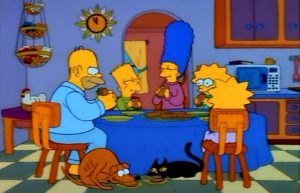
A couple of years ago, I was flabbergasted by my students’ response to “Bart vs. Thanksgiving,” from Season 2 (1990).

“It’s not realistic–they didn’t talk about Black Friday.”

I tried to explain to my students that the episode does capture an older form of Thanksgiving–one in which the holiday wasn’t linked to shopping in that strong a  way.

Sadly, the students found that unbelievable.

“Bart vs. Thanksgiving”


Share
0 comments

The Sweetest Apu

Simpsonology

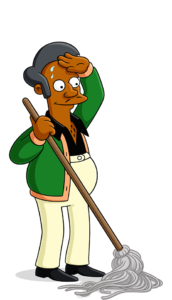
I love Apu.

I love that he stayed at a difficult job to pay off the student loans for his PhD.

I love that he has a PhD.

I love his singing voice.

I love his optimism.

I love the way his optimism is challenged sometimes, because mine is too.

I really hope that the rumors that the show is going to stop writing him into storylines aren’t true.

In many ways, I don’t get to have an opinion about this–I’m white and have the privilege that goes with it, including the privilege of most TV shows showing people with my skin type and white characters not being asked to be representative of all the real people with the same skin tone.

But if he goes, I will miss him.

If the show were introduced today, I would object to the brown-face voice.

But I don’t know if making him disappear will fix the problems he represents. Hari  Kondabolu has said his voice shouldn’t be recast, although he appreciates Azaria’s offer to step down.

But fixing the brown-face won’t fix the actual problem. If Apu had been played by an Indian (American) actor, it wouldn’t have meant that Apu wasn’t stereotypical–The Simpsons is a satire that trades in, to use Jonathan Gray’s term, hyper-stereotypes.

How would Apu exist in a world along with Chief Wiggum, Groundskeeper Willie, and Homer without being, well, Apu?

Having a different actor play Apu all along also wouldn’t have affected the two other big complaints–a) that Indian and Indian-American children are teased by being called Apu and b) that Apu is one of the few Indian (American) characters on television.

Apu is a beloved well-rounded member of the town–many episodes focus on him, and not all are about him being an Indian (American)–instead, he is a husband, a father, a businessman, a vegan, a community member, a workaholic.

I love Apu for many reasons, but it’s his workaholism I identify with. I understand how frustrating it is when people keep telling you to relax and spend time with them, how it hurts to know you’re neglecting your family. But it’s because when we do try to stop working, the guilt is intense.

(Today, I’m having trouble breathing because of the fires. The muscles around my lungs are sharply in spasm–I keep involuntarily crying out. But I’m taking a “break” to write this–after grading all day. It’s a problem.)

I don’t really get a vote about what’s going to happen to Apu. And I don’t get to tell anyone else how they should feel about it.

But I love him. And I’d miss him if he were gone.


Context: This page has a great history of Apu and a list of his appearances. Apu became an American citizen in “Much Apu About Nothing” (1996). The last episode centered on Apu was “Much Apu About Something” (in 2016). There was an episode about racial stereotypes in literature that referenced Apu in 2018 (“No Good Read Goes Unpunished”).

“In a rather high risk strategy, The Simpsons employs what we could call hyper-stereotypes. From Scottish Groundskeeper Willie and Quik E Mart owner Apu, to the show’s depictions of Japan, Australia, East Africa, Canada, and Brazil in family trip episodes, the show rounds up multiple stereotypes and jams them into one character or episode. The result, although admittedly this is a strategy that passes many by, and hence risks backfiring on itself, is to make the process of stereotyping the target, rather than the people themselves. Certainly, while many Australians were offended by a Simpsons episode set in Australia, for instance, the episode’s key targets were American behavior overseas and smalltown American mindsets that view other countries in one-dimensional ways” (Gray 64).

Share
0 comments

Karma Reviews: Sweat at CapStage

Movies & Television & Theatre

Last week, I was fortunate enough to see Lynn Nottage’s Sweat at CapStage. Sweat won the 2017 Pulitzer, and Michael Stevenson’s production is the Sacramento Premiere.

We start with a functional if imperfect community–generations have been employed by the local mill–there’s time for a drink with friends after a long day on the line.

But then the company wants to take advantage of the North American Free Trade Agreement, using the threat of closing to hurt their workers and destroy their union.

Unfortunately, this pits worker against worker, as they try to survive.

I don’t come from a mill town, but this story is still familiar. In the South, we don’t have unions–people have been able to stoke racial prejudice to keep it from happening. “It’s not that we’re exploiting you,” the rich company says. “The blacks/hispanics/immigrants that are the reason you’re poor and poorly treated.” Even when I worked full-time for a major research university there, I didn’t get benefits.

UC Davis lured me here easily, with the promise of health insurance. The union had demanded it. Right now, my union is fighting with the university for me, but the threat of us turning on each other is there.

It’s easy to see why this play won a Pulitzer–it captures us. That’s why it fits so well in CapStage’s season, #SearchingforAmerica.

It’s a heartwrenching/heartwarming story, with just enough moments of humor to help us look into the mirror it holds up to us.

The staging is simple and effective, and the acting is so beautifully done, the characters so realistic, that you half expect to see them on the line at the mill the next day.

Sweat runs through November 19th–don’t miss it.

Share
0 comments

A Writing Teacher Fantasy

Teaching

What if I could teach writing this way:

In class, we go over all the things we do now, from the development of a solid research question to fine editing.

But I don’t grade a student’s paper until it’s good.

If the student turns in something with a terrible title (“Essay 2”) or even a meh one (“Antibiotic Resistance”), I get to hand it back. “In the real world, I wouldn’t read this.”

If the introduction is boring, I get to hand it back.

If there’s no sense of audience, I get to hand it back.

If the organization makes no sense, I get to hand it back.

If the counter-argument is a straw man, I get to hand it back.

If there are a bunch of grammar errors, I get to hand it back.

If the conclusion is just a summary, I get to hand it back.

Etc.

The class would be pass/fail. To pass, the student would have to hand me a paper I was okay with (if not thrilled by) the whole way through.

Share
0 comments

Mind Reading in Santa Barbara

Misc–karmic mistakes?, Travel

A little while ago, I wrote about a particularly embarrassing moment in Santa Barbara in 2012, involving Alan Parsons and my cleavage.

But that wasn’t the weirdest thing that happened that day.

Melissa and I had just finished a conference–I had given a presentation on a writing assignment I’d invented.

We had a day to play before we headed home, so we went to a mission and then on to wine tasting.

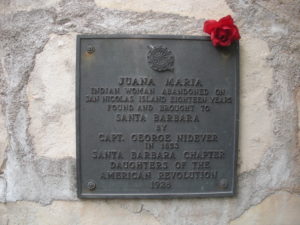
(The mission was where Juana Maria was buried–she is the real person The Island of the Blue Dolphins was based on.)

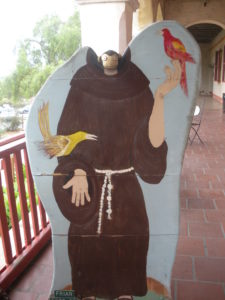
In the chapel of the mission, we came upon a statue of Mary Magdalen (the women misidentified as a prostitute in most contemporary churches).

Melissa said I would make a good Mary Magdalen. So I started singing “I Don’t Know How to Love Him” from Jesus Christ Superstar.

And we went about our day.

At one point, my mother called, but I let it go to voicemail, since we were out and about.

When we finally made it back to the hotel room after our long day, I checked the message she left.

She didn’t say anything.

Instead, the entire message was her singing the beginning of “I Don’t Know How to Love Him.”

“Oh, no!” I exclaimed to Melissa. “Can she read my mind? That’s dangerous.”

Karma on the Beach

Melissa on the beach

The Monkey in Santa Barbara

PS–This event remains unexplained. Mulder and Scully should get on it.

Share
1 comment

What The Simpsons Actually Predicts

Simpsonology

Articles come out all the time arguing that The Simpsons predicts things. I’ve written about how silly it all is before.

I’m thinking about The Simpsons today, of course, since season 30 starts tonight.

(And remembering the absolute glee of setting up the VCR to record what I knew would be awesome, all those years ago.)

The Simpsons didn’t predict Ebola or 9/11.

And they didn’t predict Trump.

Not exactly in the way people think.

They capture trends–mean-spririted voters who will vote to punish and expel immigrants, a Republican party full of rich, evil people, and Democrats too weak to fight back hard enough.

It’s not their fault they show us a fun house mirror of ourselves–our worst selves taken to extremes–and that we then become the reflection.

For example, 16 years ago, they showed an idiot celebrity decide to go into politics. “Entertainers are always winning elections.”

He runs as a Republican.

He asks the party leaders, “Are you guys any good at covering up youthful and middle-aged “indiscretions?”

They ask, “Are these indiscretions romantic, financial, or treasonous?”

“Russian hooker. You tell me.”

“Oh no problem. We’ll say you were on a fact-finding mission.”

The candidate goes on to sexually harass women and to offend Latinx people and other nations.

Since he is rich, he doesn’t connect with people at first. But then he says he’s going to fight for the little guy. And “johnny six tooth” believes him.

Fox News gets behind him.

He wins.

And he helps one family–a loyal family. He screws over poor people to do it.

“Mr. Spritz Goes to Washington” was episode 14 in Season 14.

Krusty was an unqualified joke–a literal clown–with no care for actual people–with no sense of respect for other people–with a Russian hooker scandal.

The Simpsons warned us.

We didn’t listen.

Tonight, year 30 of the warnings commences. I’ll be watching.

Share
1 comment

The Continuing Adventures of On-Line Dating: Entry 88

dating

I have just discovered that I am a petty person.

You might remember that I’ve had to block a couple of guys on Plenty of Fish recently. The two most notable blockees are an alt-right racist and a Republican who didn’t actually want to date me (just to play) and who kept saying I shouldn’t want to be with non-Republicans since they’re all guys with man buns who don’t know how to fix cars.

I’m not on POF or OKC anymore, but there’s a tiny part of me that wants to log back in and unblock these guys just to rub it in their faces that I’m in a happy relationship with a culturally Jewish non-guybunned non-conservative who has already done all kinds of fixes around here, including some plumbing.

That’s petty, right?

🙂

His name is Josh.

Share
1 comment

Alan Parsons Project

Misc–karmic mistakes?, Travel

I love The Alan Parsons Project.

Unabashedly.

And so I’m excited to see a live concert tonight at the Crest in Sacramento–last time, I had to go all the way to Napa to see them.

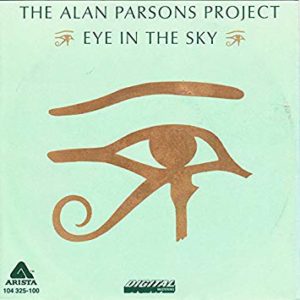
If you’re saying to yourself, that band’s name sounds familiar, but I can’t quite place it, let me assure you that you’ve heard the music–I don’t watch sports, but I still know the first song off the Eye in the Sky album, Sirius, is played all the time when stars take the court.

You may also remember that Dr. Evil’s plan, in Austin Powers 2, to turn the moon into a death star is the “Alan Parsons Project.” “The Dr. Evil Edit” then appeared on The Time Machine album.
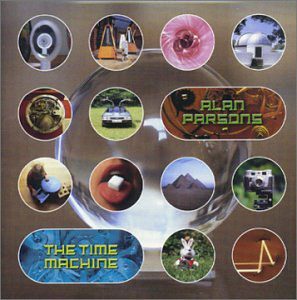
The Alan Parsons Project isn’t like other bands–various musicians cycle in and out–the constant is musician/producer Alan Parsons, most famous for his work on a couple of Beatles’ albums and Pink Floyd’s The Dark Side of the Moon, which got him his first Grammy nomination.

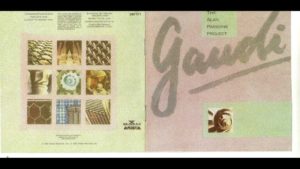
The albums the Project puts out are loosely themed. One of my favorites is Gaudi, inspired by the work and life of Antoni Gaudi, the Catalan architect, whose Sagrada Familia is still under construction (it started in 1882). It started my quest, now fulfilled, to visit Barcelona.
Other albums also appeal to the queen of the geeks side of me, with themes ranging from Keats to Poe to Freud to Egyptology.

It was probably the Eye in the Sky album I heard first–I went through all of my stepfather’s albums, looking for new friends. It was love at first listen, and I demanded that the family collection house the complete works.
One song that means a lot to me is “Prime Time,” from Ammonia Avenue. When I was a terrified 17 year old, I listened to it on repeat on the way to the hospital to have my son. “Even the longest night won’t last forever [. . .] Something in the air / Maybe for the only time in my life / Turning me around and guiding me right.]” Now, having had him in my life for 25 years, I can say it did all work out, surprisingly, amazingly, even if it wasn’t at all according to plan.

(That night did last forever, though–and by two days later, the theme song should have been the next song on the album: “Let me go home / I had a bad night / Leave me alone.”)

I’m listening to The Alan Parsons Project as I write this–my computer tells me I have 18.7 hours total.

I often listen to The Alan Parsons Project while I’m writing, which annoyed my son greatly in the Fall of 2012, when I was finishing an intensive project.

On the way to a Writing Program conference in Santa Barbara with Melissa in 2012, I relayed a conversation the boy and I had just had:

The Boy: Why are you always listening to this?

Me: I binge it when I’m writing.

The Boy: But you’re always writing!

A few days later, Karlissa spent the last day in Santa Barbara touring and wine tasting.

Near the end of the day, we were at Cottonwood Canyon tasting room. Just as our host was handing us a chocolate to have with the dessert wine pour, he mentioned his friend, Alan Parsons.

And I fell off my stool.

Literally.

I got myself up, fished the chocolate out of my cleavage, where it had fallen, and said, “The classy thing would be for everyone to pretend that didn’t happen.”

When Melissa explained why I’d been so overcome, our host insisted that the embarrassing story would be told.

“Well, when you do, tell him there’s a whole book out there written to his music.”

La Sagrada Familia



Share
0 comments

There’s No Place Like Home

Museum Musings

In our last post, we talked about the most famous museum heist in history–the theft of The Mona Lisa.

This week, we’re happy to report that a pair of Judy Garland’s ruby slippers have been found, after being stolen from a museum thirteen years ago.

We don’t know much more than that–the investigation is ongoing. You can read the BBC story about it here.

The Mona Lisa theft made the painting famous–Garland’s ruby slippers don’t need this kind of help–they are already the most valuable film prop in history.

Share
0 comments