Karma Reads: The Speed of Dark by Elizabeth Moon

Words, words, words

This week, I was engrossed in Elizabeth Moon’s The Speed of Dark.

According to the introduction, Moon wrote the book to work through her experiences with her autistic child. She imagined a future in which children like him had access to even better therapies earlier in life and in which businesses would provide more resources (for a tax break, of course).

Our hero, Lou, narrates most of the book, though we get flashes of other points of view in third person. He is high functioning, high functioning enough to critique his mandated therapy appointments with a therapist who underestimates him.

Lou navigates pressures at work, including a new boss who thinks people shouldn’t get accessibility resources, his fencing club, friendship, and a crush.

One of the pressures is that his new boss wants him and other employees like him to try a new therapy to become “normal.”

Should we treat children with autism? Should we try to cure the hearing impaired?This is a contentious topic in disability studies–we do not have consensus on how to balance understandings of disability with difference, defect with culture.  In our current social model, of course, “disability” is a key word–without that label, protections and accommodations aren’t guaranteed. In other words, if we took the “disability” label off students who were hearing impaired, they would no longer be eligible for signing translators in their classes.

Lou and his friends have to try to both figure out how to advocate for themselves and to decide whether they want to try to be “normal” instead of who they are.

While the book was compelling, I didn’t find the ending satisfying. It felt a bit rushed.

Still, I recommend this thoroughly. I couldn’t put it down.

Share
0 comments

Karma Watches: The Wolves at CapStage

Movies & Television & Theatre

The Wolves is an ensemble play by Sarah DeLappe. I was excited to learn it would premiere at CapStage after it won an Obie and was shortlisted for the 2017 Pulitzer.

It’s the first play in their new season–#SearchingforAmerica.

What director Nancy Carlin gives us is indeed a piece of America.

The Wolves consists of us watching a series of warm-ups that the Wolves, a high school soccer team, do before games. It’s done in a naturalistic style.

Naturalism is related to realism, but is actually more realistic. In extreme naturalism, if people are supposed to be cooking, they would be cooking for real. If something were supposed to smell bad, the audience would smell it too. Naturalism is called “slice of life” theatre.

In this case, it means that sometimes a few characters have their backs to us–and that when these girls talk, we are experiencing what it sounds like to overhear many girls–overlapping conversations, half thoughts, and cuss words.

If this play were done in a realistic style, I probably wouldn’t like it, but the naturalism works.

We see what we see–nothing gets solved. No story gets fully told. There is no happy ending, because there isn’t an ending. The majority of the girls are juniors, so they’re not even reaching the end of senior year at the end of the play–we just get these practices–to see this tiny slice of their lives (and all the hints at more). There are colds and crushes, small deals and big ones.

The slices are familiar–what I heard as I was leaving was people remembering their own clubs in high school, their competitions, having to go to their daughters’ practices.

The play is a tight 90 minutes–and the actors are surely exhausted by the end–they’re basically playing soccer for a standard game time, after all.

This is the kind of play that really works in the intimacy of CapStage’s theatre–you’re always just a few feet away from the actors, so you’re beside them when they accidentally insult each other, when they apologize, when a fight almost breaks out over one girl leaving the other vulnerable to an older boy pressuring her for sex. We are right there with them.

We are the wolves.


Share
0 comments

TA Flashbacks

Teaching

About a third of the way through my guest lecture, the professor said, “I’m going to stop you there. I don’t agree with your feminist reading of the text.”

I was Professor Levin’s TA in a Shakespeare course. I already had my Masters–I’d written a book to get it, on the figure of the witch on the British stage, from Shakespeare to Churchill. Chapter One was about Macbeth, and even though I didn’t use it in the book, I’d written another chapter about witchcraft in The Tempest.

Thus, when Levin invited me to give a talk, I proposed a brief talk based on that.

The Tempest features a mage, Prospero, which is tricky, since King James really hated witches.

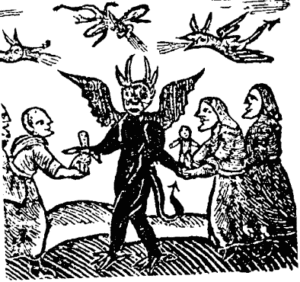
He had written an entire book about them, Daemonologie, in which he explained how all magic is in service of the dark forces, with tangents about how it’s possible for the Devil to impregnate a woman, since he can’t make sperm (spoiler: he gets sperm from a corpse).

While all witches were bad, he did make a common distinction between male and female magic. Male magic was “white”–it’s what learned men did, in trying to compel the spirits. Female magic was “black,” base, sexual, and destructive. Women were controlled by the devil and usually gave their body to him to seal the pact.

My point was that Sycorax, the unseen (dead) witch in The Tempest was there to foil for Prospero (she is rumored to have gotten pregnant by the devil, etc.). One could view the play with more sympathy towards Prospero due to her (and because Shakespeare allows for multiple interpretations, one might realize they’re not that different).

I got cut off, though.

I had to leave the lectern and take my seat in the back of the room, before Levin told the students that he didn’t approve of feminist theory and that they should forget everything I’d said.

Some of the students emailed me, apologizing for their professor’s behavior, saying they wished they’d been allowed to form an opinion about my point, if only they’d been allowed to hear it.

On the way out of class that day, Levin had asked where I’d gotten all that crap about James’s views.

“From his book, as I said. Have you read Daemonologie?”

“No.”

Every time I teach Shakespeare, as I am this summer, I think about this interaction.

And about the lesson.

A professor stopped a point of view he didn’t understand before hearing it out.

A male professor made a woman sit down before hearing her out.

I’m sure the students learned from that–that he would punish them for even proposing an interpretation he hadn’t thought of.

And that the sexism of King James’s time is still very much with us.

Share
0 comments

Celebrating the anniversary of one of history’s biggest art heists: The Mona Lisa

Museum Musings


Ever wonder why the Mona Lisa is such a big deal?

Sure there’s her enigmatic smile, and the mystery surrounding the identity of the model, and the oddly fantastical landscape in the background. And, yes, she was painted by one of art history’s darling geniuses, Leonardo Da Vinci, who was also a self-taught engineer, master procrastinator, and persecuted bisexual–for all of which we love him even more.

But though Mona Lisa (who also goes by the name La Gioconda) was born in the 16th century and has been on display in the Louvre since its opening shortly after the 18th century French Revolution, she was well-known primarily among the French art intelligentsia until the early 20th century.

On today’s date, August 21, in 1911, Mona Lisa went missing, but her absence wasn’t noticed for 28 hours.  At first, museum staff assumed she’d just been misplaced. Imagine losing track of the Mona Lisa today!

In a short bit of time after the theft was announced, Mona Lisa became a worldwide celebrity. Her photo splashed newspapers around the globe and one New York Times reporter remarked that the theft had caused “such a sensation that Parisians for the time have forgotten the rumors of war.”[1] (Pre-World War I tensions between France and Germany, had already become heated at the time.)

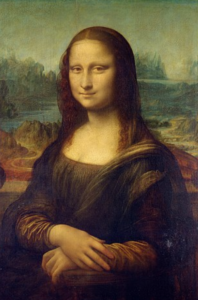
Mona Lisa, Leonardo Da Vinci, 1517

Two years passed before authorities recovered the painting, during which time newspaper readers everywhere followed the efforts to track her down.

The Mona Lisa had been lifted off the wall, removed from her frame, covered in a blanket, and carried out of the museum by three Italian immigrant workmen at the Louvre. As it goes with immigrant groups everywhere, Italians were much maligned and exploited in early-20th century France. It’s possible that the three thieves were simply trying to take down the master’s house, or that they thought they could profit from selling the painting on the black market, or that, as ringleader Vicenzo Perugia claimed, they were on a patriotic mission.

When he was arrested for the heist, Perugia said that he was simply trying to return a painting that Napoleon had looted from Italy to its proper home. If he sincerely believed this, he was mistaken. Da Vinci himself had given the painting to King Francis 1 during a time when the painter was living in exile in France.

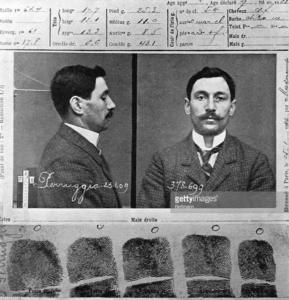
Vicenzo Perugia’s Mug Shot

During the two years that Mona Lisa was in Perugia’s possession, she lived in the false bottom of a trunk in the thief’s tiny apartment. Today she hangs behind bullet-proof glass on a wall in the Louvre, and it’s hard to get anywhere near her. You’ll have to elbow your way through all of the other adoring fans to get 2 seconds with her and snap a selfie that will likely turn out bad because of her bullet-proof enclosure.

You can thank Perugia for the fact that you know about the Mona Lisa and for your lousy selfie.

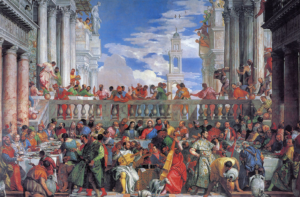
Mona Lisa is highest valued painting in the world, estimated at $782 million in 2015, and the Louvre is the most visited art museum in the world, receiving over 8 million visitors in 2017. Many of those visitors come just to see the Mona Lisa, which is good for her and not so good for many of the other artworks in the museum. Just across the gallery from Da Vinci’s painting hangs Veronese’s masterpiece, Wedding at Cana, which most visitors rush by without a glance in their haste to get a glimpse of that famous smile.

Wedding at Cana, Paolo Veronese, 1563

If you’d like to know more, listen to art historian Lorraine Kypiotis discuss the theft on the Australian Broadcasting Corporation. Or, for an amusing take on the incident, watch Season 5, Episode 9 of Drunk History. They don’t get all of the historical details right, but watching Jack Black play Perugia is priceless.


[1] “‘La Gioconda’ Is Stolen in Paris” Special Cable to THE NEW YORK TIMES.

New York Times (1857-1922); Aug 23, 1911.

Share
0 comments

This American Life’s “The Feather Heist”

Museum Musings

This American Life has a fantastic story out this week about “The Feather Heist“–a flute player broke into the British Museum and took millions of dollars worth of not pinin’, but passed on, no more, ceased to be, expired and gone to meet their makers, stiff, bereft of life, resting in peace, pushing up the daisies, metabolic processes stopped, off the twig, kicked the bucket, shuffled off this mortal coil, run down the curtain, joined the choir invisible, ex-birds!

Share
0 comments

Karma Reads: Alone Forever by Liz Prince

Words, words, words

The other day, while browsing through my library’s awesome graphic novel collection, I happened upon Liz Prince’s Alone Forever: The Singles Collection.

It’s weird that I hadn’t heard of Liz Prince before, since I’m into comics and sadly often on the dating scene.

This collection is a quick read; it’s also funny and familiar, from the wild things our minds do when we first crush on someone, to the judgmental ways we read each others’ OKC profiles.

Reading this also answered a question for me.

In the last few years, it’s been hard to find a guy without a beard (I can deal with trimmed ones, but those bushy ones turn me SO off–I think it’s because that beard signaled, in my Southern childhood, a redneck/racist/civil war obsessed guy.)

Someone must like guys with beards, I’ve been thinking to myself. Who?

They couldn’t all have them if someone didn’t want that.

It’s Liz. Liz wants that.

Share
0 comments

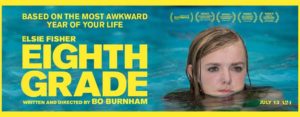
Karma Watches: Eighth Grade

Movies & Television & Theatre

Eighth Grade, written and directed by Bo Burnham, is brilliant.

Translation: it’s so true, so good at capturing that awkward, horrible age, that it’s hard to watch.

But you still have to watch it.

The film follows Kayla during her last week of eighth grade–Burnham makes an innovative choice here–we just see this week–no flashbacks, no explanations for how this young woman came to be–just a stark picture of how she is.

Two things have followed me after sitting with this movie for a week.

First, there is a scene in a car with an older boy. I have been in that car, many times, trying to get away.

I heard myself, when I was in ninth grade, say to my first “boyfriend”: I don’t know why you want to sleep with me. I don’t even think you like me, considering how you treat me.

That was me, young and naive, pleading for my boyfriend to try to pretend he liked me.

(The other thing about this film that I keep thinking about is Kayla’s dad–and how I wish I had had one like him. Kayla gets to come home and scream and cry after being in that car.

I would usually come home to discover that my stepfather had forgotten I was gone and locked me out.)

Elsie Fisher is amazing as Kayla–at times, this felt like a documentary, due to the realism in her performance. Her father, played by Josh Hamilton, is perfect in capturing the ways in which parents are befuddled by their offspring at this age.

At this point in life, I watched this movie identifying both with Kayla and her father. I have been the trainwreck, and I have also been the parent who sees the wreck about to happen and who can do absolutely nothing to stop it.

There is just no way to protect our children from being thirteen.

Share
0 comments

20 Years of Teaching

Teaching

Today is my birthday, but this month also marks an important milestone for me. I’ve been teaching for twenty years.

I wasn’t always sure that this was what I was going to be, despite the amazing teachers I had, how much I enjoyed tutoring and directing, and the empowerment and escape path I found in education.

I had a year between undergrad and grad school, and when I started grad school in the summer of 1998, I was sure of what I wanted.

Especially after I got to guest teach for the first time.

If the feeling I had had happened in a church, I’d be a nun now.

I’d like to claim it was inevitable, and I could make that case–I’ve seen my permanent record. (I asked my mom for a note to see it when I was in high school–I wondered if the rumors about it were true.)

One of the first notes, from my kindergarten teacher:

“Karma displays leadership abilities on the playground.”

And so here I am, displaying leadership abilities on the playground of higher education.

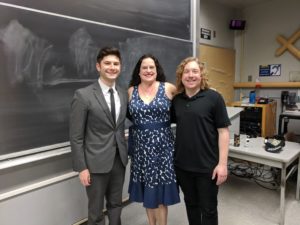
In these twenty years, I’ve taken several pedagogy courses, including a film pedagogy course, I’ve made a video for my students on better editing, I’ve mentored (officially and unofficially) many students, worked with our at-risk students, written two pedagogy books, served with our campus book program, done library outreach, created courses, worked with student interns, been an interim director of a program, served on committees, overseen comp exams, worked with local theatres, brought speakers to campus, significantly contributed to scholarship in my fields, edited Prized Writing, served on two dissertation committees, gotten my students scholarships and into graduate schools, facilitated the stand-up comedy club, etc.

I have won the 2015 AF Excellence in Teaching Award.

And then there are the courses.

I think this is the complete list (two of these years at Florida State, getting a terminal masters by writing a book–yes, a book, for a masters; six of these years at UCD, getting a PhD, during which for one year I just TAd; and then full-time at UCD for the rest; adjuncting for Los Rios; I’m only counting courses for which I was the sole instructor):

Freshman Comp: 25

Writing About The Simpsons: Satire and Postmodernism. This turned into a book and a freshman seminar at UCD that I’ve taught over a dozen times. 2

Great Books of the World: 2

Young People’s Lit: 1

Storytelling: 1

Multicultural Children’s Lit: 2

Science and Speculative Fiction by Women: 1

Introduction to Drama: 1

The Short Story: 1

Writing Research Papers: 2

Witches: Myth and Literature: 1

Performing Arts Today: 1

Contemporary British Literature: 1

Fantasy Literature (in Oxford): 1

Group Study (travel writing): 1

Style in the Essay: 7

Graphic Novels: 4

Writing in Education: 3

Writing in Film: 2

Writing in International Relations: 7

Writing in Health Science: 23

Freshman Seminars (British Humour, Science and Literature, Doctor Who, Margaret Atwood, The Simpsons, Stand-Up Comedy): 41

Advanced Composition and Rhetoric: 30

Grad Course: Writing in Performance Studies: 4

Writing in Business: 2

Shakespeare: 2

Writing in Fine Arts: 2

Tutoring in Writing: 2

Independent Studies: 8

Grad Course: Writing in Forensic Science: 1

Introduction to Fiction: 3

Introduction to Lit: 8

Developmental Writing (Workload): 63

If my math is correct and if I’m not forgetting a course or two, I have taught 255 courses so far.

(I refuse to do the math on how many papers I’ve graded.)

Not bad for someone who had a less than 1% chance of getting a BA.

Not bad for a chronic pain patient.


Today, I’m stressed because I have to finish grading two classes; two more start Monday.

But I’m excited about those courses.

And, as I remind my students, I have an amazing job. I get paid to think. I tell students what I think, they write down what they think, and then I tell them what I thought of that.

🙂

There’s no way I could have done everything I have if I didn’t love this.

And part of what I love is seeing them grow, into better writers, better thinkers, and sometimes better people.

The other thing I love is having that rare relationship with a student that grows into a real friendship.

(You know who you are.)

So thank you to all my students, except for the baker’s dozen that have really pissed me off (it’s amazing that it’s only about a dozen–fewer than one a year–who has really been a problem).

Thank you for your patience, your encouragement, your laughter, your hard work, your willingness to let me experiment, your friendship.

Share
0 comments

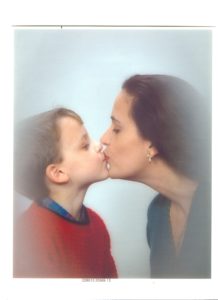
25 Years of Alexander Dante Waltonen

Family & friends

Me, in my senior year of high school (92-93):

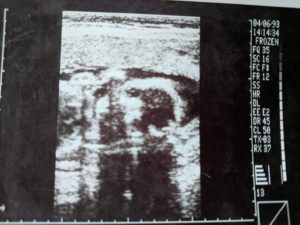
In the Fall, I unexpectedly started growing this:

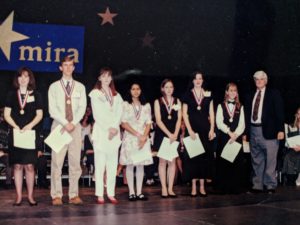
The first time I felt him kick, I was getting an award, but I couldn’t tell anyone there about his achievement, since he was still a secret:

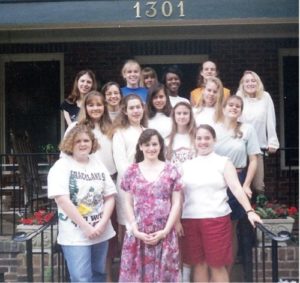
When I did finally tell people, in my third trimester, one of my friend’s moms threw me a shower:

He was born after graduation, 6 days before I turned 18.
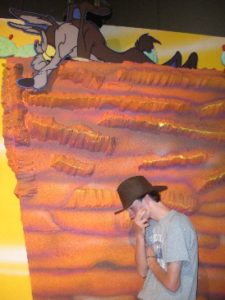
The nurses told me it was weird that he furrowed his brows. “He’s got a lot to think about,” I said. “The other babies don’t do that.” “Mine does.”

I didn’t have much of anything for him. Or anyplace to go, until my (grand)daddy came for us. The other mother who shared my hospital room gave us her second car seat, so we could leave the hospital legally.

This is him, with his great-great grandmother, Bessie:

This is him, unhappy because we let the swing stop:

Despite our difficulties, we managed to be okay, almost always on our own. He didn’t know we were poor or unusual. When people would comment on how young I looked, he would patiently explain, “she was in high school when she had me!”

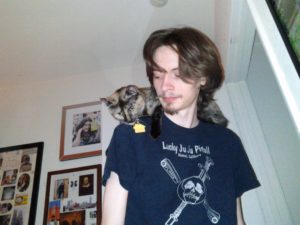
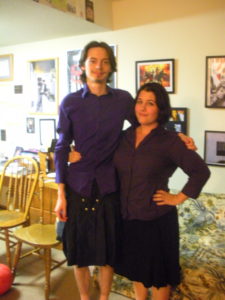
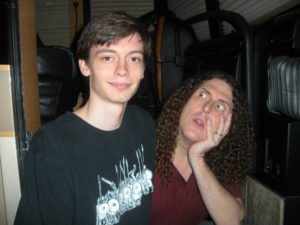
We have been together for 25 years. We built a good life in California, filled with friends and laughter and Simpsons and books and travel and Weird Al Yankovic and kittens. 

I love you more than anything. Here’s to the rest of our time together.

The most dapper on-site coordinator

Share
1 comment

Continuing Adventures of OnLine Dating: 87: We’ll Never Know

dating

This morning, I was alerted that someone had sent me a message on Plenty of Fish, but the message is not in my inbox.

There are two reasons this might be–the person sent the message and then deleted his profile (or the site deleted it).

Or–and this is more likely–the person sent the message and then blocked me so I couldn’t respond (and the person is too stupid to get that blocking me means I can’t see the message).

The person’s handle: Gods1fan.

Gee, I wonder what he might want to say to me, while also making sure I can’t respond. . .

Share
0 comments