Voting in America

Politics and other nonsense

Sometimes, when I ask my students a question like “which reading do you want to talk about first,” I get only one or two people responding. I often make a joke about democracy not working with so few votes.
The Supreme Court may grapple soon with efforts to make it harder to vote, to discourage voting. Striking down so much of the old Voting Rights Act has had some frightening consequences. In other words, deciding to trust states not to try to disenfranchise black voters has opened the door to the disenfranchisement of young, poor, and voters of color. Of course, the issue isn’t really about race anymore–if black people voted Republican, they wouldn’t be getting screwed now.
The new laws in various states controlled by Republicans are designed to ensure that Republicans can vote and that others may not be able to. Voter ID laws, getting rid of early voting, etc–these all target the urban, the poor, the young, the old, who may not have a picture ID or who may not be able to get to a polling place easily. One Texas law, which accepts a gun ID, but not a student ID, as proof of identity, could not be clearer in terms of who is encouraged to vote.
Those who support these laws say the laws are there to reduce voter fraud. When confronted with the less than 1% incidence of voter fraud, they will say that even one fraudulent ballot is worth all the trouble.
I don’t happen to share that view, because I’m offended by the idea of lots of people not being allowed to vote or having their ballots thrown out just in case there’s *an* invalid ballot.
I take this personally. When the Supreme Court stopped the absentee ballot count in the 2000 election, they stopped a count that included MY vote (I had just moved to California).
I can’t help but think of our already low voter turnout and why anyone actually interested in democracy (as opposed to oligarchy) would try to make it even lower. I think about other countries, where voting is required or where election day is a holiday or where people are automatically registered the second they become an adult. These countries don’t seem to have problems with voter fraud.
We need an updated Voting Rights Act, one that focuses not on race as the only thing officials might be taking into consideration–we need one that makes voting as popular and accessible and vibrant as it deserves to be.

Share
0 comments

Weird Al’s Grammar Lesson

satire, Words, words, words

Weird Al’s latest album, Mandatory Fun, features an upbeat parody of “Blurred Lines”–“Word Crimes.” The narrator of the song gives some grammar and word choice lessons, including the correct use of the apostrophe and “literally.” Weird_al_yankovic_word_crimes_titlecard
Grammar Girl (Mignon Fogarty) objects to the song, saying, “I don’t expect a music video to get into the details, but what I see is that he’s appealing to the base instincts that I’m tired to the bone of seeing: The call to feel superior and to put other people down for writing errors.”
She notes that some people have argued that the video is a parody of grammar nazis (it can be read that way, although I agree it’s unlikely to be). I noted on FB that we should refrain from automatically assuming that the artist and the narrator of a song are the same person. After all, on the same album, Al sings that he wears a hat made of aluminum foil because “there’s always someone that’s watching you / And still the government won’t admit they faked the whole moon landing . . .”
However, the artist’s views on grammar are well known. Al does care about language. He has even made videos about correcting signs.
(Mignon, whom I adore, argues that his corrections are sometimes unneeded in the same article.)
But I just don’t share her disdain for the song or the video.
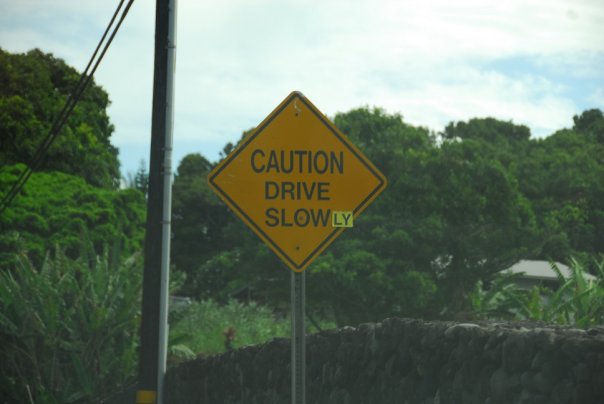
A small part of this is because of my love of Al. One day, years ago, I was in Maui. My then boyfriend and I happened upon a street sign that had been corrected. The boyfriend noted that my soul mate must be near. Later that evening, in his catch-up on all things Al (because he’d known me long enough to be converted), he found a video of Al correcting that sign that very day.

drive-slowly
It’s not a coincidence either that I identify with the narrator of another Al song, who breaks up with a woman because of her inability to distinguish between “imply” and “infer”–I use those lyrics on a word choice handout.
I haven’t encountered anyone else who’s bothered by “Word Crimes.”

The music editor of The New Yorker described the video in an article: “Brackets and exclamation points dance as Yankovic defines contractions and counsels against using ‘c’ to mean ‘see.’ But Yankovic never comes off as a scold. Every aspect of his art is enthusiastic and cheerful, a throwback to an earlier era of comedy and pop culture, when lightness had validity.”

However, it’s possible that The New Yorker writer and I aren’t bothered because we don’t make those grammar mistakes–we aren’t the target of the song. Grammar Girl is worried about students viewing the video in class–as people with bad grammar are insulted in it. I’ve been the indirect target of jokes like this before, though. The Simpsons has lampooned people who teach college classes on cartoons and those who have taught at Florida State (as I have). I have had arguments about the relative virtues of Kirk and Picard, like the people Al skewers in “White and Nerdy.” In one of Al’s new songs, “Tacky,” he wears an airbrushed shirt as a signifier of tackiness. One of my airbrushed shirts has Al as his Simpsons avatar. I’m still laughing. weird1

Grammar Girl said she hated to hate this song. I hate to say that I think she’s overreacting a bit. I don’t think this is going to do much damage even to the most sensitive grammar-challenged person. And, even though she might say it makes me a mean person, I like the song because I identify with it. I have friends who literally cringe when “literally” is misused. Denise and I had to fight our editors on the first book because they said my example of an its/it’s mistake might be too subtle (due to its commonality) for people to understand. Denise and I wanted it in for exactly that reason–it’s one of the most common errors out there, and people need to learn to fix it (if only because one of the ways people narrow down the pile of applications is to throw out the ones with an error).

I had a relative who thought I was pretentious because I spoke correctly as a teenager–I wasn’t trying to be, but I was already a reader, already a writer–and it would have been especially pretentious for me to try to dumb down for a grown man (it was just a lose-lose situation). I don’t correct signs. I don’t correct people outside of work, no matter who much I sometimes want to. But I’ve been fighting the good fight for writing properly in my classes for a while now. Each year, it gets harder. In the last couple of years, I have had students turn in formal essays with “you” written as “u.” In the last year, I’ve had several students refer to themselves as “i.” One student claimed he didn’t know he was supposed to capitalize that word.

This is in a university where we only accept people in the top of their class.

Sometimes I just need to know that I’m not the only one bothered by this. Add a catchy tune and my soul mate singing and two double entendres, and I can’t complain.


Share
0 comments

On The Simpsons, the Marathon, and the Modern TV Audience

Movies & Television & Theatre, Simpsonology

Tomorrow marks the start of something historic–a full Simpsons marathon on FXX. (It will take 12 days to do every episode.)
Afterwards, FXX will be putting The Simpsons into regular rotation. (I’ve always managed to live somewhere with a local affiliate showing it at least once a day–every other country I’ve visited (UK, Spain, Canada, Finland) has also had regular daily showings.
FXX is also hosting an APP–Simpsons World–that will give unparalleled access to the show (every episode, episode guides, etc). I mean, I have this access (as I’ve recorded every episode of the show and I have all the guides), but this APP will make things easier (no flipping through heavy books, etc). (Further thoughts on the APP are below.)

This marathon/APP launching has increased interest in the show, which will begin Season 26 in the Fall.
A few weeks ago, I was on the anniversary show of a podcast on 90s culture, discussing the best show of the 90s.
Denise and I have several original essays to edit for our new Simpsons collection (and are looking for publishers now).
Tomorrow, I’m going to be on Radio Times with Marty Moss-Coane, a live, public-affairs talk show out of NPR’s Philadelphia affiliate, WHYY (at 8 a.m. Pacific Time).

simpsons1

And then there are all the articles, online and otherwise.
I have to say, I find it somewhat disheartening that so many articles about the show start with a cliche about how the show is beloved, but not good anymore or simply postulate the show needs to go off the air.
In truth, the show itself hasn’t changed all that much since its “heyday”; rather, it changed the world of television, bringing us animation for adults, sitcoms without laugh tracks (and thus a faster pacing in the comedy), imperfect lower class families, TV families that actually watched TV, postmodern pastiches that mix high and low comedy, and satire for the masses. It took a while, but then a lot of other shows started imitating the innovations. And then, over the years, new shows with new innovations (like cartoons not just for adults but sick adults like me and my friends) came along.
The Simpsons should certainly not attempt to mimic these shows, to keep pushing the television envelope. It ushered in a revolution; it should not attempt to one-up Archer. (Something will, though. Archer will become quaint. Whatever makes it so will shock us for a while, until something comes out to make it seem old.)
The Simpsons is basically the same. It’s we, the audience, who are different. We expect a lot now–because the show has taught us to. Because the show opened the door for so many other shows to experiment. And we watched those experiments–and we keep expecting more.
And then we get cranky & say The Simpsons is not funny or relevant anymore.
Hey, you don’t have to like it now–you’re a different audience than you were.

But so am I. And I still think it’s funny. True, there are not as many episodes that catch me the way my old favorites do (it should be noted, of course, that not all fans agreed that what we now consider the best episodes were good–“Deep Space Homer,” one of my all-time favorites, was often lambasted by viewers at the time).

Karma & Moe

Karma & Moe

However, there are still new episodes that do catch me. “Coming to Homerica” was an instant classic.
There are still jokes that make me laugh way too much (such as Maggie’s “first” word–in Norwegian–and her mother’s reaction to it, in the above episode).
And there are still episodes that move me. “Lisa Simpson, This Isn’t Your Life” features Lisa going to a private school, as she has often wanted. Lisa hurts Marge deeply in this episode, insulting her mother, her mother’s choices, her mother’s intellect, her mother’s choice to be a stay-at-home mom. However, Lisa then finds out that Marge has taken on some demeaning and grueling work to allow her to go to this school. It’s hard to watch that moment.

I care about the series & its characters. One of the things that makes The Simpsons special is that the characters are imperfect, but lovable. The shows’ imitators (with the exception of Bob’s Burgers, which is excellent) have often neglected this part of the equation. You can kill Kenny hundreds of times, and not just because he’s coming back. I’d actually cheer if they killed Peter Griffin; I can’t watch him verbally and mentally abuse his daughter anymore. And Stewie can insult and try to hurt Lois until the end of time. There may be moments of humor, but I won’t feel for Lois, who cannot apparently be emotionally hurt (and is thus unrelatable), nor do I have a reason to understand Stewie’s vendetta.

Lisa’s tension with her mother, and her mother’s ultimately loving response takes me back to what I loved about all those old episodes people apparently long for–the moment when Bart writes “Hero” on his father’s bald head, when Homer tries to win his daughter back after her crush on a teacher exposes a problem in the father-daughter relationship, when Marge takes Homer back, despite his tattered rags being caught on the coffee table.  Fox Lot1
The other reason for my annoyance at the naysayers is a selfish one. I have friends who work on the show. I have no doubt that I could continue my teaching and scholarship on the show once it’s off the air (in the same way we still read that damn Shakespeare guy), but I want my friends, who are writing jokes, animating scenes, composing music, and putting everything together to keep doing what they love.
Especially since what they love is something I still love.
(And, c’mon, The Simpsons is still better, even in a not great episode, than 95% of the crap on TV; 40% of all people know that!)

*****

Further thoughts on the APP:

I have to admit that I’m not sure exactly how the APP will work. I still have a dumb phone, so I don’t use APPs. This APP, though, is digital, meant for cable subscribers. On the one hand, that means I can get it, but it might also means that it won’t be as useful for my students as I’d hoped. Right now, when I teach the show, I have to show many of the episodes in class, which takes away from our talking time, since they don’t have access to the episodes streaming anywhere. However, most of my students only watch TV on the computer, meaning they aren’t cable subscribers. We’ll see.


Share
1 comment

Hobby Lobby: Controlling Your Neighbor as Yourself

Politics and other nonsense

I honestly didn’t think that The Supreme Court was going to go this way on the Hobby Lobby case. In what universe, after all, could my boss’s religion be imposed upon me? Why would we, who fear “the government being in our exam rooms with our doctors” allow our bosses to be there when we have our legs in the stirrups?

Nevermind that Hobby Lobby is inconsistent, allowing both male birth control and free viagra and investing in birth control products in their portfolios.

Nevermind that Hobby Lobby falls victim to the same logical fallacy that all anti-contraception/anti-abortion forces do: limiting access to birth control when access to birth control lowers abortion rates. These people hate, hate, hate abortion, but seem to hate–a) women’s access to baby-free sex, and b) logic–more.

Nevermind that, as many commentators have noted, this is only going through because the religion in question is Christianity. The Supreme Court previously denied applying the principle in question to Native American groups who wanted access to their traditional herbs in ceremonies. And, as Bill Maher noted, if this company were Muslim-owned, and they wanted the insurance plan to align with Sharia law . . .

Nevermind that the precedent set is dangerous in two ways. 1. The ruling opinion says that this is about what the employer “believes.” What if my boss believes that a woman’s body should be a temple in case she happens to get pregnant? After all,  many drugs could harm a fetus if they’re in a mother’s system. People shouldn’t conceive on depression medication or bipolar medication, after all. And, even if a woman doesn’t plan on getting pregnant, even if she’s on birth control, it can still happen. What if my employer believes even sillier things? What if he thinks my asthma medicine is an abortative? Since this is about his belief now, I guess my access to breathing is up to him.

2. This ruling can be applied widely–it’s not just about birth control. Some employers are already trying to get it to apply to their treatment of gay people, arguing that it’s against their religion to not discriminate. Decades ago, some employers argued that their religions allowed them to pay women less and to treat women differently. The Supreme Court told them no, but this newer religious freedom statute may allow it now. And, in terms of health care, some religions forbid blood transfusions, and some forbid any medication at all.

Let’s leave all that for now.

The upsetting aspect of this that isn’t being talked about enough is what the Hobby Lobby people and the majority decision said will be done about those women who do want birth control. You see, since it’s a horrible burden for Hobby Lobby to have birth control in its healthcare plan, the women or the government is supposed to figure out how to make sure women have access to a perfectly legal product that the United Nations and the WHO recognize as a basic human right.

Let’s say women should figure this out themselves. I know women who haven’t been on hormonal birth control due to its cost. (Insurance helps a lot.) An IUD can be hundreds of dollars. The pill, without any insurance, ranges from $37 to $162. Not all women, by the way, can just opt for the cheaper version. Our bodies are complicated–it often takes a long time to find the right pill. The wrong pill can cause BIG problems. And even if a woman can go with the cheaper version, sometimes $40 a month is a lot. When we think about the women who need this most–women of childbearing age on the margins–women who live (supporting themselves and often others) on or below (in the case of many undocumented women) the minimum wage–women who live on or below the poverty line–$40/month is sometimes not an option.

Let’s say the women can come up with the money. They buy and use the birth control. Where did that money come from? From their employer! Oh, no! Money from Hobby Lobby (HL) is going to birth control! It’s just instead of HL giving money to Kaiser and Kaiser giving access, HL gives the money to the woman, who gets her birth control . . .

Which brings up another problem. You see, when we receive health insurance from our employers, it’s not a gift. It’s part of our salary–part of our compensation package. We factor it in when deciding to take a job. (I moved to California because UCD, unlike schools in the South, offered healthcare to graduate student workers.) My paycheck includes information about my gross and net and also how much my organization puts into my healthcare. This month, for example, I paid $193 as my portion of insurance. UCD paid $1084.

Somewhere in all of that money is my birth control. Companies who refuse to allow birth control in their health care plans are thus not only denying women a basic human right & inserting their religion into the lives of their employees. They are also cheating their employees out of part of their pay. They are ignoring that these employees also pay into their insurance (and thus should be able to avail themselves of the whole plan). They are insuring that women who want to use birth control must pay the same amount for their insurance, but must also come up with $37-$162 (without, of course, any increase in pay to compensate for the loss in their payment package).

Unless, of course, the government subsidizes healthcare for these women, as HL and the court implied it might have to do. Now, where would that money come from? Taxes. Taxes on the woman who’s being cheated, taxes on me, who, as a “middle class” person, pays a very high tax rate. Taxes on corporations. Thus, HL would be paying for birth control again–just to the government instead of to the insurance company. Unless it, like many corporations, manages not to pay taxes.

And that’s another problem–a problem we as a country seem to be ignoring. Corporations keep shifting the burden of basic life expenses onto the rest of us.

Why, when a woman has access to insurance, should my taxes be required to grant her birth control?

Because corporations would rather I pay it. After all, we live in a world where many low-wage workers, many Walmart employees and fast food workers, have to also live on public assistance. They’re fighting a rise in the minimum wage, saying they can’t afford it.

My fellow taxpayers, they can afford it. We’re the ones who can’t. We’re the ones paying enormous taxes for “entitlements”–assistance to people who work, but who aren’t paid a living wage.

The Hobby Lobby decision is not just the furthering of the Christian-theocracy agenda in this country; it’s not just the start of a dangerous precedent; it’s the strenghtening of our corpocracy–of corporations shifting the basic burdens of payment onto everyone else.

And what do they say about this? One man I heard on NPR, who won’t be giving his female employees access to birth control, said that if the women didn’t like it, they could go work somewhere else.

Yup. And if she can’t find that job, maybe she can get some birth control through her welfare package. Problem solved.




Share
3 comments

& even more readings

Words, words, words

The library is recalling a lot of books, so it’s time for some short assessments as I try to clean out one of the shelves here.

Graphic Novels
Lynda Barry–The Freddie Stories. It’s a quick read, and some moments are engaging, but I got irritated by each two page spread being its own chapter. Why? Because many of the stories of course took more than two pages–the small interruptions into the flow of the tales wore on me. Or maybe I just like Barry in smaller doses overall.

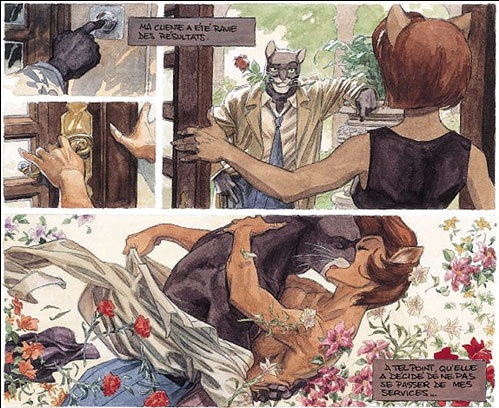
Juan Diaz Canales & Juanjo Guarnido–Blacksad (and Blacksad: A Silent Hell). If I ever get to teach the Spanish literature course (in Spain) that I’d like to, I will teach Blacksad. I really, really love the art. I enjoy the way these Spanish artists depict New Orleans, where Blacksad resides. However, it’s sometimes hard for me to get into the stories. Blacksad is a P.I. He and the other characters in the books are anthropomorphized animals. However, the P.I. thing just doesn’t always work for me. For example, I find it almost laughable when Blacksad takes on the case of a murdered former lover: “Out there, hiding somewhere, was the guilty one. Guilty of at least two murders, for he had killed a person and my memories.” Except, um, we just saw his beautifully illustrated memories, so . . .

For example, this memory, from Blacksad

For example, this memory, from Blacksad

Ursula Vernon–Digger Volume 2. The Digger series won the Hugo in 2012 in the Graphic Novel category. Digger is an engineering Wombat who enters a far off land through a strange hole. She tries to find her way back. It took me a long time to figure out that Digger was a woman, by the way, which is also why I like the series. She’s a digger, but not one for traditional human gender roles. Solid black and white art.

Francesco Francavilla–The Black Beetle: No Way Out. A superhero mystery. I didn’t get past the first few pages. A hot, vulnerable female scientist gets attacked by mysterious strangers. She gets saved by another mysterious stranger. There’s a mystery here, but I’m just feeling the cliche.

Inoue–Pepita. This is a sort of graphic (including pictures) travelogue as the Japanese artist Inoue explores the work and life of Gaudi. One of my great dreams is to see Barcelona one day so I can see Gaudi’s work up close. It’s always called to me. This is for people who love Inoue or Gaudi or architecture in general, but definitely not for everyone.

Darryl Cunningham–How to Fake a Moon Landing. This is a non-fiction text. Cunningham devotes chapters to debunking anti-science myths (like the Moon trip was a hoax, like there’s no global warming, etc.) One chapter which confused me was the anti-chiropractor chapter. Cunningham does not like chiropractors. He says they claim they can cure diseases with physical manipulation and that no one should ever claim they can fix back pain (he strangely says that nothing can cure it and also that drugs are safer). Cunningham is British–maybe that’s the issue. My American chiropractors have never spouted the nonsense he says they do. And I’ve actually had many issues completely resolved through chiropractic treatment, after trying drugs and the other stuff. (But no, nothing can “cure” long term back pain. However, both drugs and chiropractic can help manage it.)

A Gaudi apartment building

A Gaudi apartment building

Prose Fiction

Kate Milliken–If I’d Known You Were Coming. Highly praised short story collection. I read this in book group a few weeks ago. I don’t remember most of the stories now. They were well written, but nothing is staying. Nothing needs that second read.

Gary Shteyngart–Absurdistan. Now that I’ve read a few satires in novel-length form, I’m more convinced that satire is really best when short. Our rich Russian hero is spoiled, fat, and absurd. He is emasculated in every way, but it doesn’t matter because of his money. His father’s money, to be precise, has every woman throwing themselves at him and men clamoring for his attention. The one woman he loves, though, allows herself to be drawn into an affair with her professor. Our hero ends up in Absurdistan while trying to leave Russia. People think there’s oil. There’s a little uprising. & so on. There are funny moments. Those who know about satellite nations and the problems of countries like Moldova will like this better than those who try to read it from a purely American lens. But overall: meh.

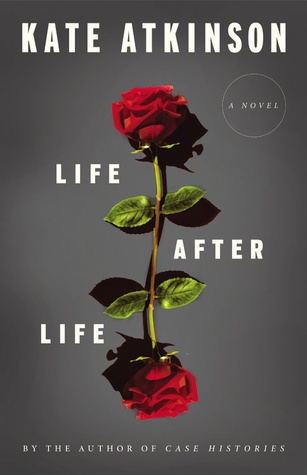
life afterKate Atkinson–Life After Life. Our heroine dies. A lot. Her life then restarts, and through small changes, she survives. Sometimes longer. Sometimes not. She sometimes does things she can’t explain (pushing someone down the stairs to guarantee that a train will be missed, etc.) It took me a while to get into it, but once I did, I loved it. Great backdrop of WWII (there’s even a life where she knows Hitler). Deservedly award-winning.

Ruth Ozeki–A Tale for the Time Being. This beat out Pynchon for an award I assume only goes to the very post-modern. You see, a novelist named Ruth is our narrator. She finds a Japanese school girl’s lunchbox (complete with diary) on the beach after the Japanese tsunami. I was completely taken by the Japanese girl’s story, which involves her father’s depression, her being bullied, her fabulous grandmother (a nun). Ruth’s story was boring to me (though one member of book group had the opposite response), as it was just her reading the diary, not worrying enough about her husband’s missing cat, and doing internet research to try to find the Japanese girl. A good read, but I would cut out a lot of Ruth. And I wouldn’t recommend this on a kindle (mine, anyway. There are footnotes to translate some of the Japanese, but my kindle won’t show footnotes until the end of a text).

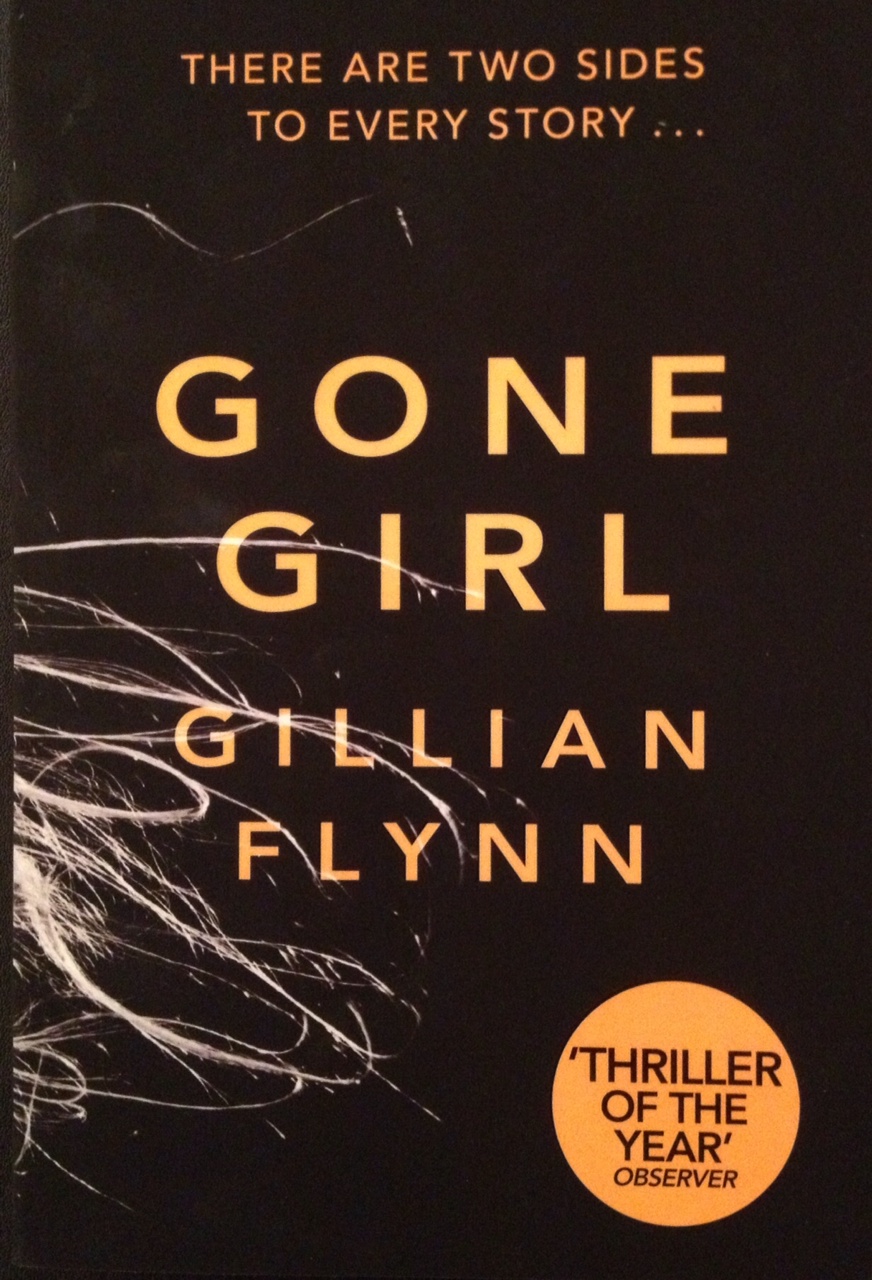
Gillian Flynn–Gone Girl. Melissa had recommended this to me some time ago, and I just got around to reading it this week. In the first part of the novel, you have the narration of a man whose wife goes missing on their anniversary and the narration of the missing wife’s diary. One of them is lying. Thoughtful page turner. Recommended. gone-girl

Jo Baker–Longbourn. I couldn’t get far into this. It’s the story of a maid at Longbourn–the Bennet house in Pride and Prejudice. Our narrator is not subtle (some of the ideas that should be teased out are spelled out for the reader, so they don’t miss them). In the first few pages, a mysterious male employee joins the household and is a jerk to her. Gee, I wonder what’s going to happen.

Share
0 comments

Some Recent Readings

Misc–karmic mistakes?, Words, words, words

etiquetteDespite everything, I have been able to get a bit of reading done. Below are some brief reviews:

We Can Fix It!: A Time Travel Memoir by Jess Fink. I didn’t finish this. A woman time travels back to see her younger self. She ends up having sex with her younger self. Repeat. Repeat. And it’s not even sexy. No time travel paradoxes are even mentioned. From the part I read, there was no real point. It seems more like a masturbatory fantasy in graphic novel form than anything else.

The Property by Rutu Modan. Another graphic novel–a good read about a family that travels back to the old country to attempt to reclaim a property that was lost when the family had to flee Europe during WWII. Well-drawn, solid story.

Gris Grimly’s Wicked Nursery Rhymes. This wants to be Gorey and Gaiman. It’s not.

Batman Incorporated by Grant Morrison. Batman begins to start franchising himself so more cities have his trademark protection. Fine idea and all, but I’m just not into it enough to keep going.

When David Lost His Voice by Judith Vanistendael. I couldn’t finish this one either. It’s described as a “tone poem”–those are tricky enough to get through sometimes when they aren’t in graphic novel form.

The Middleman and Other Stories by Bharati Mukherjee. I picked this up recently because I’d read and enjoyed “The Management of Grief,” about people who gather after their relatives’ plane has gone down near a foreign small town. I like the beginning of another story here, “A Wife’s Story,” which begins with an Indian woman watching Glengarry Glen Ross and having a bit of a fit about the characters’ casual racism. But then something happens common to most of the collection–richly described characters experience angst. They are just about to do something that will shift their lives, and then the story ends. We don’t get to see whether they’re lives get shifted, how it feels to have sex with that stranger, to quit the job, etc. I felt empty at the end of almost every tale.

The Surrogates by Robert Venditti and Brett Weldele. Another graphic novel–this time presupposing a world in which surrogate bodies have mostly replaced ours. We send our avatars (younger, fitter) out in to the world to have sex with our husbands, to catch criminals, etc. (Crime is actually down because hurting the avatar is only property damage.) Yet there’s rebellion from those who believe we should encounter the world in flesh. Will we be ready to if they win?

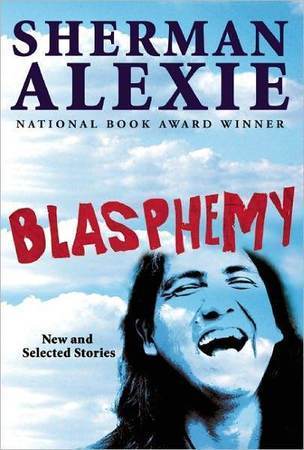
Blasphemy by Sherman Alexie. This is a collection of classic and new stories. I love Alexie and find his short fiction often superior to his novels. Perfection. la-ca-sherman-alexie-20121014-001

Gail Carriger’s series: The Parasol Protectorate and The Finishing School. I had unfortunately tried to read the second book in the Parasol series, not realizing I had book 2, some years ago. Reading both series in the right order has been wonderful. It’s steampunk fiction. Parasol is for adults–set in Victorian England–in which our smart heroine must deal with a world in which steam power reigns and in which vampires and werewolves live alongside the sometimes inhospitable humans. The writing is light and sexy (especially in the first book). Our heroine’s moments of panic are usually both because someone is trying to kill her and because fleeing might expose an ankle. The Finishing School series is for young adults and is set in a finishing school for female spies and assassins. It serves as a prequel to the Parasol series, as some of our young ladies have grown up for Parasol. So good.

Share
0 comments

Seeing Peter Sagal

Misc–karmic mistakes?, Movies & Television & Theatre

On Friday, April 11th, Ian and I headed in with a full crowd to see Peter Sagal, host of Wait Wait, Don’t Tell Me. The Mondavi center promised a behind the scenes look at our favorite weekend show, but Sagal gave us a talk about a miniseries he did with PBS instead: Constitution USA. Sagal introduced us to several people, all of whom believe in the Constitution, all of whom have very different ideas about what it’s meant to do for them.

My three take-aways: 1. Sagal is funny in person too. 2. He pointed out that our constitution is the first and shortest, because our founders were smart enough to know it should be brief and vague enough to let us adapt it as we evolved. 3. The Constitution only works because we believe in it. Lots of other countries have one–many of them are repressive regimes. Their constitutions are sick jokes–more like PR for the international community than a document that makes rules and guarantees rights for their peoples. As Sagal said, our constitution is like Tinkerbell, and we gotta keep clapping.

I was disappointed that we didn’t really get to talk about Wait, Wait, disappointepeter-sagal-at-worshipd in Davis for booing when he mentioned that we used to be Berkeley’s farm (we did–why shame him for bringing it up, even if he did find it funny?), disappointed that even with Q&A, we only got an hour and a half. On the other hand, it’s half an hour more than I usually get with him.

Share
1 comment

The Encyclopedia of Early Earth (review)

Words, words, words

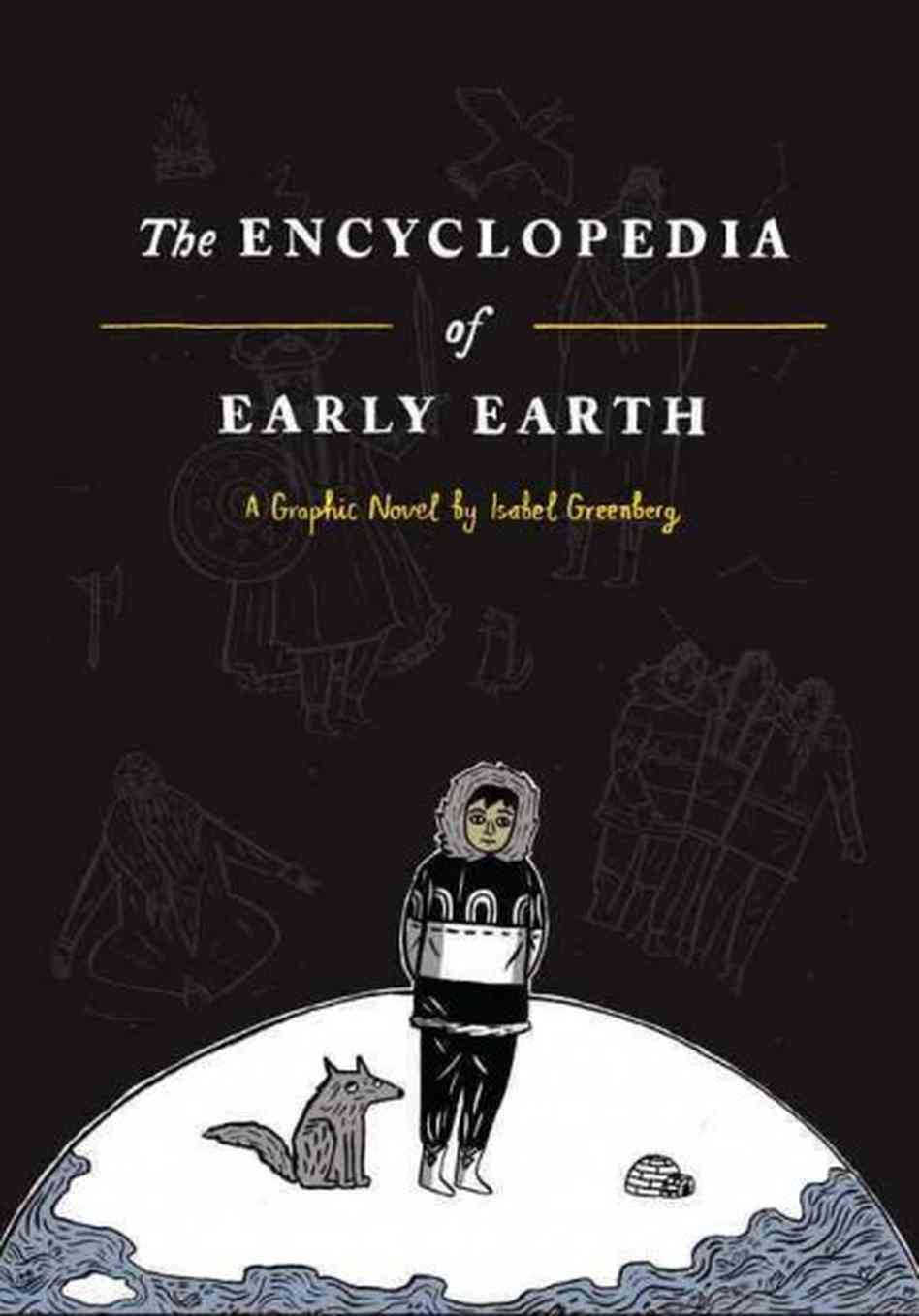
I did my semi-annual library order of new graphic novels recently and have been slowly going through them. The Encyclopedia of Early Earth has already been recalled by another patron, so I had to move it to the top of the list, only to find that it’s by far one of the best in the pile.

cover

cover

Published last year, the book is by Isabel Greenberg, a London-based author. This is her first full-length graphic novel.

It’s not an encyclopedia–it is, however, a collection of myths and stories about “early earth”–a time before our recorded history (but with events and peoples much like we find in our recorded history. Some of the myths are familiar–we see them in the Judeo-Christian tradition. The book would have us understand that the early earth myths were first (the reader can decide if these stories survive in the Jungian collective unconscious or whether certain events repeat a bit)).

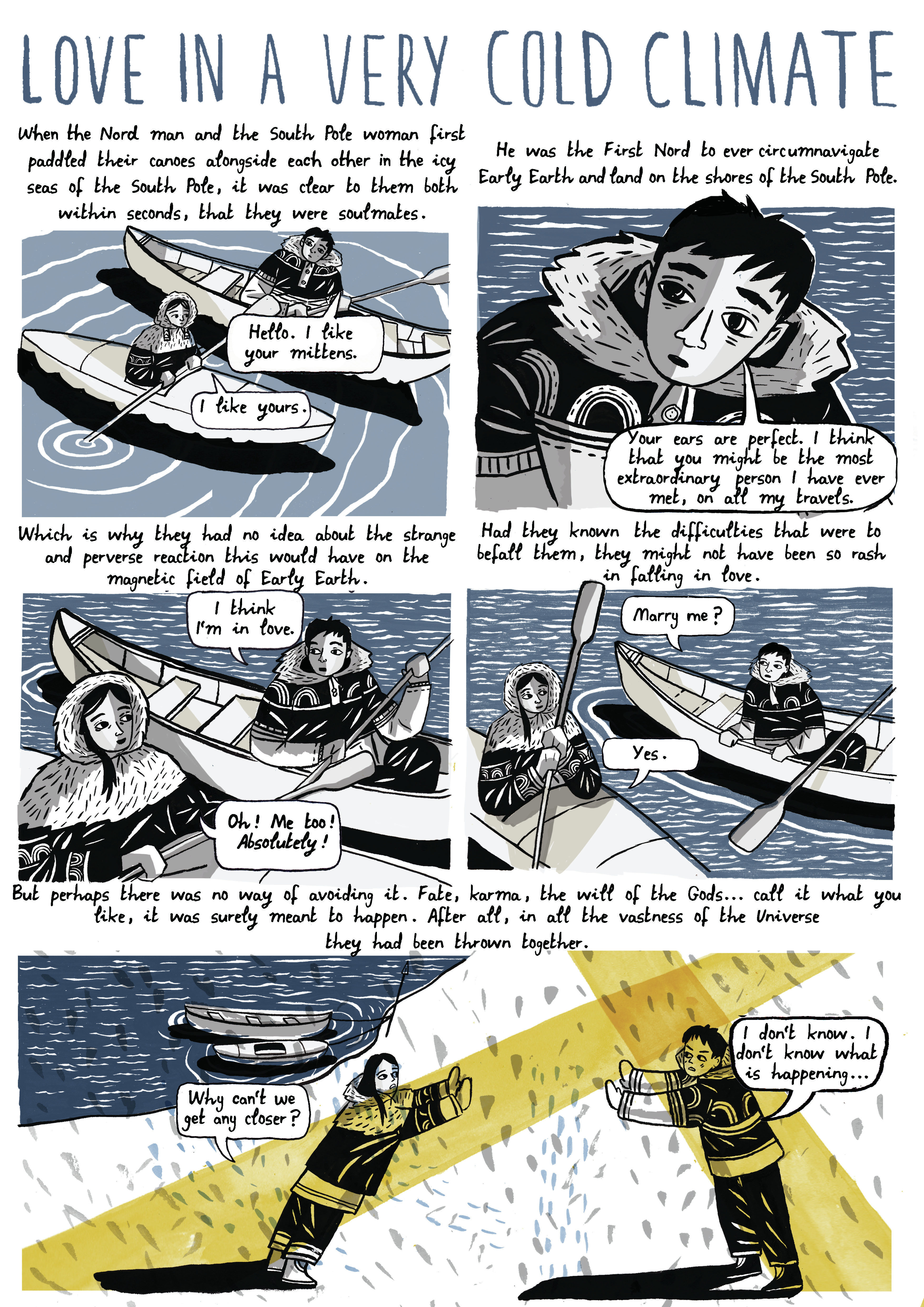
The book is about storytelling, but the real joy is that Greenberg is a master storyteller herself. I blew through this book and loved it all. The art is a great complement to the stories, with lovely lettering, clean lines, and a masterful use of color.

It’s so good, in fact, that I’m willing to forgive its small flaws–it has an appendix, for example, with some background stories. As this is actually organized as stories–with stories within stories–and not as a document, it doesn’t really make sense to have an appendix. Those tales could have been folded into the others. However, I was thrilled to see the appendix when I came to the end of the book today–it meant there was more to read!

love-in-a-very-cold-climate9780316225823_1.480x480-75

Highly recommended! I can’t wait to see what she does next. I’m also going to have to go find her graphic short fiction, for which she’s won an award.

Share
0 comments

My Xolair’s In!

Misc–karmic mistakes?

Later today, I will finally get my xolair shot, only three full months after I was supposed to get the last one.

It took me being on the phone with several different people for hours. It took my shot nurse doing the same. It took my medical advocate doing the same. It took faxes and pdfs and tears.

Those of you who have been following the saga know that I used to pay $9/month for my xolair (thanks to Genentech’s xolair assistance). Blue Shield told me for over two months that I would pay $125/month + 40 for the nurse visit. Yet I couldn’t order the drug because BS was telling the pharmacy something else. Then BS told me that they had been wrong–all five people I’d talked to were just wrong–and that my copay was just under $1100/month (+40).

Here’s what we now know actually happened:

BS was wrong on their authorization form–they listed a pharmacy that was actually out of my network (“that was an error”); that cost me a week.

BS was wrong when many, many people told me to set up an account with the pharmacy and to order the drug. The letter they sent me, addressed to me, addressing me in second person (“your provider . . .”), was, they admit, “confusing” as it seemed to also tell me that I had to order the drug, when, in fact, the doctor’s office was supposed to do it.

BS was wrong when they tried to bill $1100–both because I was apparently not supposed to order the drug myself, but also because that copay would only apply to this drug if I had an out of network doctor. My plan is the UC Care plan, made especially for UC Davis Employees who use UC Doctors. My doctor works at the UC Davis Medical Center. When I get bills from there, I have to write checks to the Regents of UC Davis. When I got switched to this plan, I called BS to confirm that all of my doctors, including this one, were in my network. So how could I possibly expect them to get this right, even when the authorization lists this very doctor as being one of their providers? Silly me.

My copay is actually zero. I will have to pay $40/month to see the nurse, so under the new insurance plan, my cost goes up $31, which is, of course, fine. I just wish I were allowed to make this many mistakes as a patient/bill payer. I just wish my lungs hadn’t been hurting for a couple of months. I just wish I could get all those hours back.

And I wish they weren’t giving me more BS about a procedure I need on my neck, turning it down.

How am I supposed to trust them now?


(In other news: my students’ stand-up performance is here: http://webcast.ucdavis.edu/llnd/1bf40024 I’m the MC, so I do some stuff at the start and in-between. I was basically workshopping all new stuff, so it’s not polished.)

Share
0 comments

The Year So Far (February edition)

Family & friends, Misc–karmic mistakes?

I haven’t been in the kind of contact that I want to be with most of you. Part of it is that I’m busy. Part of it is that I don’t necessarily want to talk about how I am.

I was really hoping that this year would be better than last. Last year was busy (no surprise), but also difficult due to my gall bladder, an amazing cervical spine headache that started in summer, and a car accident, which resulted in hours of physical therapy each week (it’s only ended last week).

This year hasn’t been easier so far. I’ve already written about my grandmother dying last month. What I haven’t said yet is that, while she was sick, this particular time of death didn’t have to be. What I haven’t said yet is that I’m angry about some of my mother’s decisions and angrier about her refusal to acknowledge them.

Next month, I will return home during Spring Break. My family is waiting to put the ashes in the ground until I get back. I need to try to have a calm conversation in which I explain to my mother that she can’t change my grandfather’s medicines, etc. without notifying the doctor. But she’s going to get defensive, and we’re going to have a fight, and I’m stressing about it.

The other thing I haven’t said is that it really sucks to be the only woman in the world with the middle name Jewreen. Before, there were two of us.

As for myself, three things are going on physically. Today I have a tube going from my stomach, out of my nose, and to a recorder. It’s testing the ph of my acid reflux and also checking to see if some of the reflux ix actually bile, now that we know I have some bile in my stomach. I am very uncomfortable, doubting I’ll be able to sleep tonight, and looking forward to getting it out after my classes tomorrow. Some of what we’ll learn will determine if the doctor thinks I need surgery for the hernia in my esophagus.

My inclination is not to have surgery; however, the drugs I’m on haven’t been controlling my reflux symptoms like they used to. And I’m on the highest dose of things.

I was finally able to see someone at the pain clinic for this cervical spine headache in December. We are looking at doing a nerve burn in my neck–pain medication isn’t doing anything, nor are the non-invasive things like massage, etc. Friday, I had a nerve block, a sort of test to see if the nerve burn would work. The very temporary block had wonderful effects, although I’m sore and swollen from the procedure. My insurance company wants me to have another test block done before they approve the burn, which would be longer lasting.

Lastly, one of the drugs I need, xolair, is expensive and weird. When my insurance changed at the start of the year, I had to try to get reauthorized for it. It’s now almost the end of Feb–I’ve been off my drug for almost two months. Both my nurse and I have spent hours on the phone with insurance and hours on the phone with the specialty pharmacy. It looks like I might finally be able to get back on the drug next week, though my copay will be lots higher. And then the insurance company wants to reevaluate in June. Every dose they can prevent me from having saves them thousands of dollars.

The other big news is that my aunt Mindy is not doing well. She is now basically too disabled to work. She has been living with my cousin for the past few months. My cousin’s husband, however, is getting transferred to Guam. My aunt has been unsuccessful so far in getting insurance, etc. (The Southern States have not expanded medicaid to poor adults.)

The short version of this is that Mindy will be coming to live with me at the end of Spring. It will be a bit tight–I don’t have the money right now to move us to a three bedroom. But I at least should be able to get her the care she so desperately needs.

Work is fine. The students are understanding about papers coming back two days late the week Gma died. They are understanding and sympathetic about the awkwardness of a tube coming out of my face today. My stand-up class is a joy.

I gave a smart and amazingly attended presentation at a Writing Teacher’s Conference in January. Had a good MLA. I’ve applied to be the coordinator for the Upper Division Comp exam. I’ve got a paper coming out on (a)sexuality in Sherlock. The Prized Writing Ceremony went swimmingly–the Chancellor was there for the first time, and she enjoyed it so much that we’ve already scheduled next year’s so she can be there. I’ll present at pca/aca in April (no more conferences for the year, though–too broke). The Margaret Atwood journal is going online. I’ve been contracted by Cambridge for an Atwood collection. The authors are writing now. Denise and I are putting together a Simpsons collection. Melissa and I are putting together a collection of best comp paper assignments. There are and will be plays and movies and, in April, Willie Nelson. Book group still gathers here for food, wine, and cats. When HBO or BBC is doing something good, there are weekly movie nights too. The boyfriend cooks for me and distracts me and pleases me. Alexander is generally in good spirits. He doesn’t love all of his classes. (His classes are part of me being broke.) But we get along well.

Just today, he reminded me that I wasn’t allowed to use the microwave (due to the weird machine I’m wearing). Then, when I thoughtlessly went to the microwave half an hour later, I got the same tone from him that the cats do when they jump on the counter.

My friends are lovely. I miss you and love you all.

Share
0 comments