I was catching up on my Colbert this afternoon, wanting especially to see the interview with Jon Stewart. They talked about the election, the virus, and our overdue reckoning with institutional racism.
As part of the latter, they drew attention to how two white guys were talking about racism, and how some white people can only hear about racism from other white people.
Jon mentioned that he, Jessica Williams, and Jordan Klepper had a bit in which Jessica would talk about racism, Jordan would shut her down, Jon would restate Jessica’s point, and then Jordan would agree.
The best Daily Show with Jon Stewart video that does this is “Helper Whitey,” a discussion about the confederate flag. (ooooh, timely too)
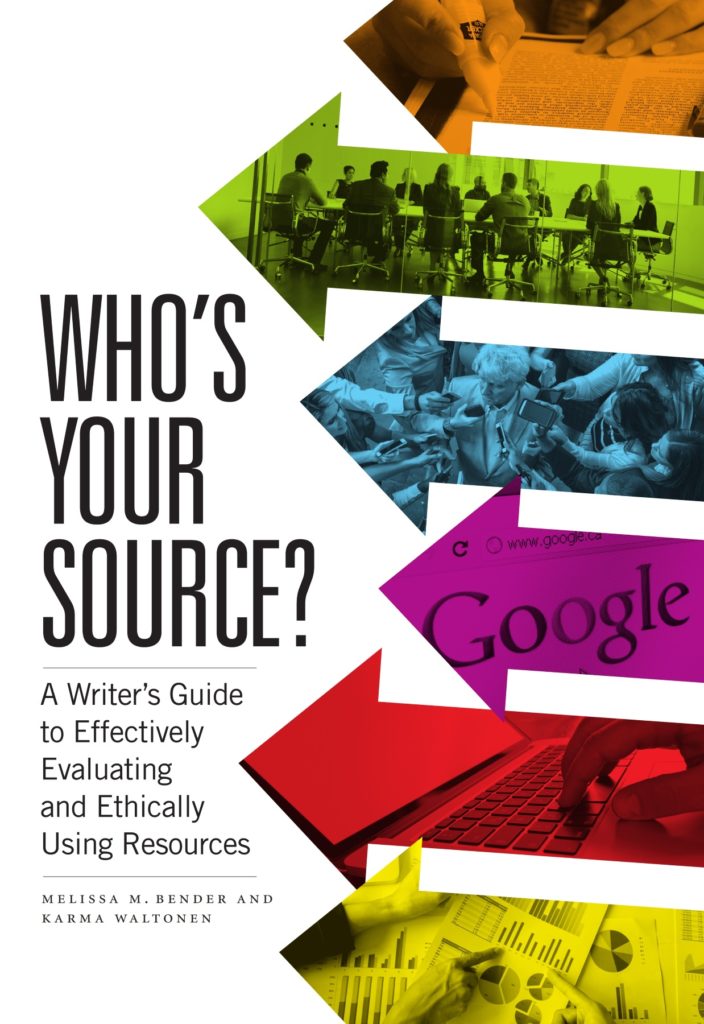
Karlissa actually tackles this ridiculousness in our new book. When discussing ethos, we should remember that some people, those not inclined to agree with you, will dismiss you for having too much ethos. Too many whites don’t believe black accounts of racism. Too many men don’t believe women’s accounts of sexism.
And that’s why we all have to speak out. I’ve seen white students’ resistance fade a bit when I talk about white privilege, just like I’ve seen some men’s shoulders go down when another man embraces feminism.
This isn’t going to surprise anyone who isn’t a Fox News viewer, but it’s worth noting.
This Washington Post article discusses three scientific studies, showing that Fox News viewers, regardless of age, race, sex, party, were less informed and more likely to believe conspiracy theories about the virus.
While many of the examples in Karlissa’s book on sources are funny, this newer one is definitely not.
The lies disseminated by the network are directly affecting people’s lives, literally. Viewers were less likely to follow government guidelines for safety. One study “provides evidence that those behavioral differences are contributing to the spread and mortality rate of covid-19 in certain areas.”
Last week was my summer vacation, the only week until Christmastime when I don’t have one or six classes running.
Here’s what I did:
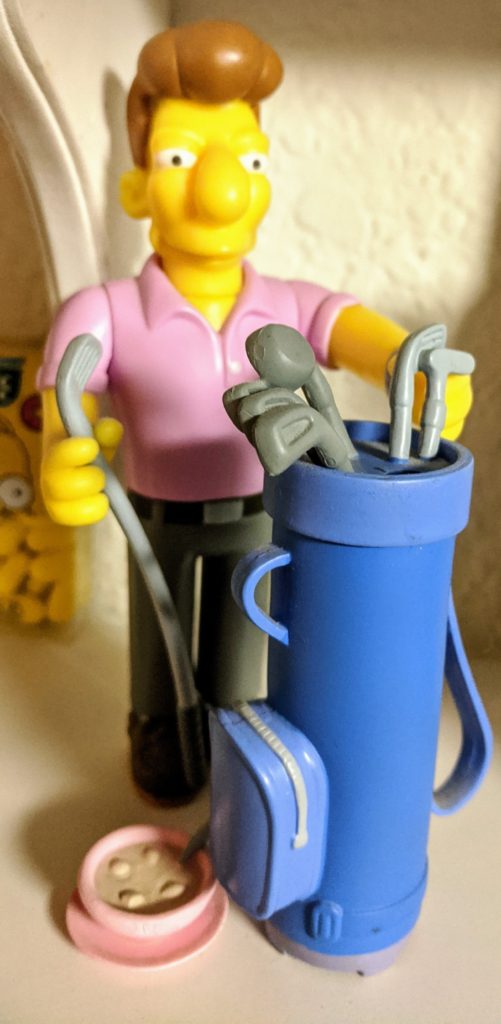
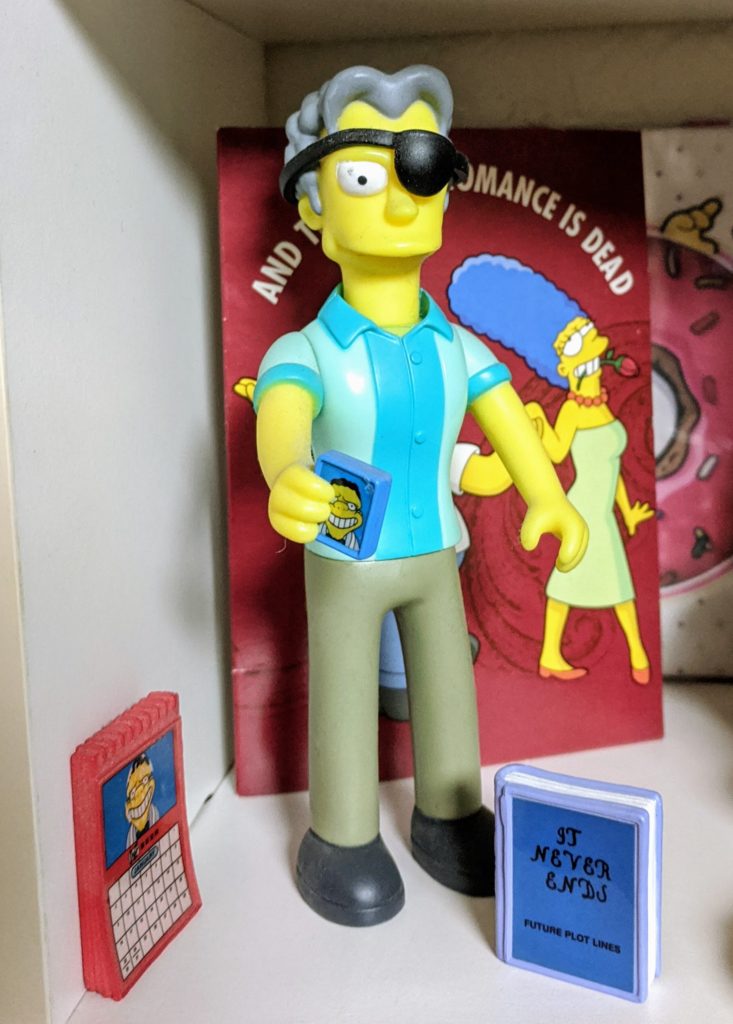
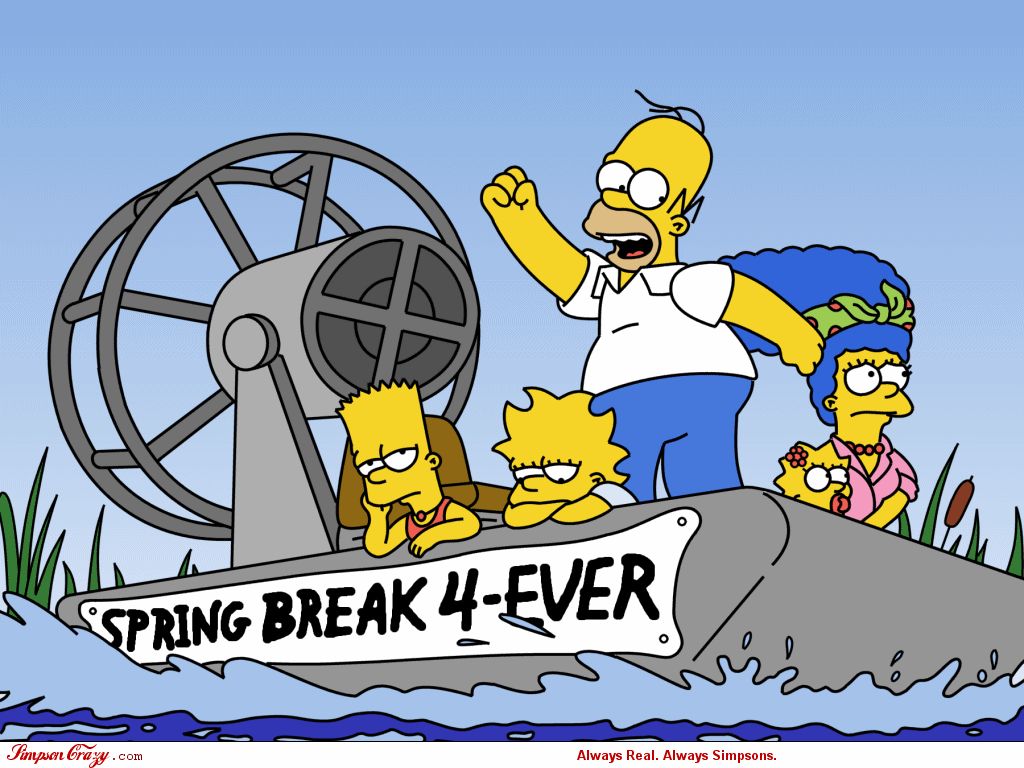
Deep cleaned the downstairs, including taking every single Simpsons piece off the shelf and dusting it.
Freddy Quimby comes with a bowl of ChowDAIRE!Handsome Moe comes with the script for his Soap Opera, the Duff calendar, and his sponge.
Appeased my neighbor, while upsetting the cats.
Several months ago, a neighbor asked me to keep Thoth inside. He sometimes poops in her garden. He’s friendly, so he likes to say hi, which is why she thinks it’s him.
I’m not saying it’s not him, but the neighbor thinks Thoth is the only cat who ever goes into her garden, which I find hard to believe. We have many strays in this neighborhood. And unlike Thoth, who approaches every human, the strays don’t like you to watch them use the toilet.
We’ve been keeping Thoth inside for over twelve hours a day, encouraging the neighbor to spray him, to use cayenne, etc.
She sent a message recently to ask if we’d walled him completely off yet. In the last three months, she hasn’t seen him, but there’s been poop in her garden once.
Once.
In three months.
So I paid hundreds of dollars last week to have a task rabbit guy come into my house and put up chicken wire around the patio fence. Thoth is like a velociraptor in Jurassic Park. He’s testing the fence, finding the weaknesses. And he has found one, which we have to fix somehow.
He’s also crying and pouting. He really loves saying hi to the neighbors, which I know cause they text me from blocks away to say he’s hanging out with him and that he’s wonderful.
He’s beloved in the neighborhood, except for that one neighbor.
I got myself a present.
A decade ago, when I lived in a place with a yard, I had a hammock, and I loved it.
I don’t have one now. Instead, I have a few feet of dirty concrete surrounded by chicken wire.
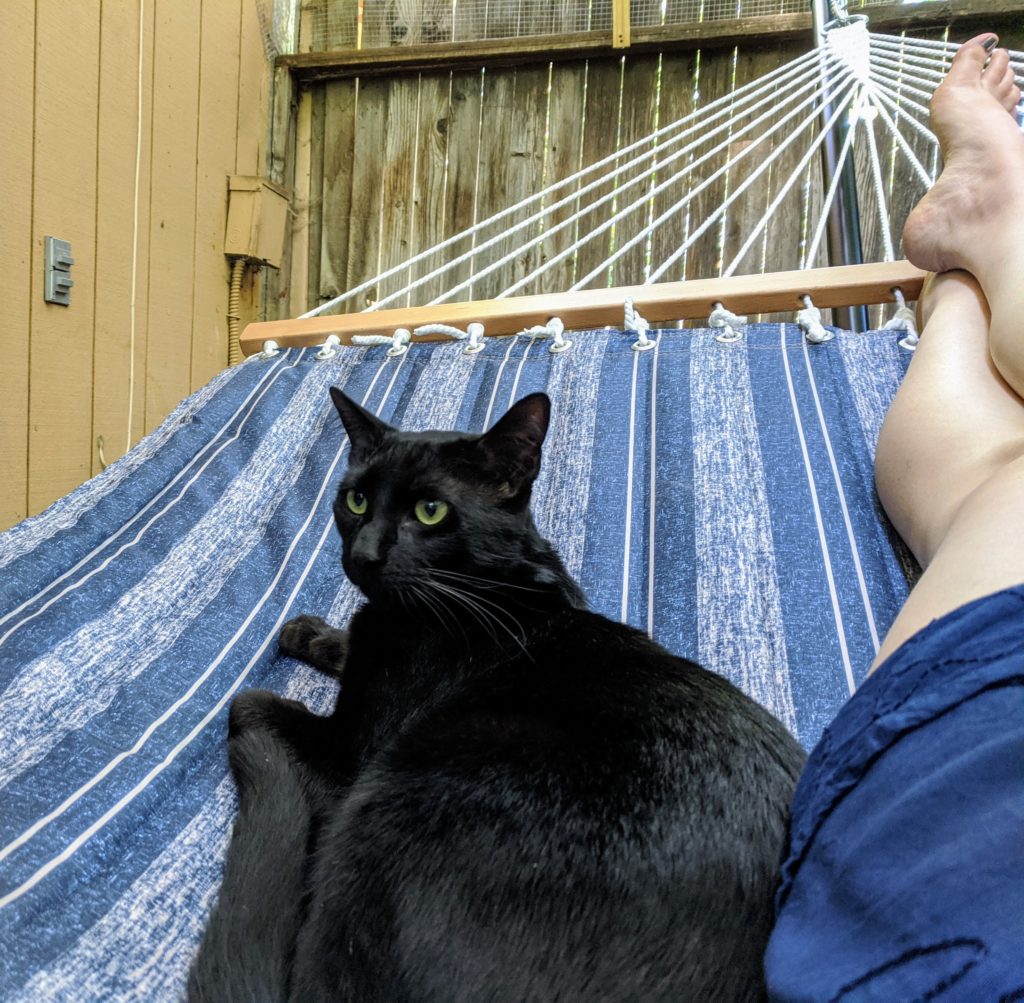
But I bought myself a hammock, and the redwoods give a lot of shade. Lying on it with me has been the only time Thoth is happy in the last few days.
view from the hammock
Now that home is home, the office, the classroom, the restaurant, the gym, and cat prison, there might as well be a work hammock.
I got a Covid-test, treatment for my bursitis, and an endoscopy. The third thing took way too long, and took too much out of me, and my hand is still terribly bruised, but as least all the tests were negative.
I judged Prized Writing essays, I answered emails, I did some last minute prep for the class that started this week.
I watched Keith Lowell Jensen’s stand-up.
I saw my seniors do their stand-up comedy send-off fundraiser. And felt so proud I got teary-eyed.
I made ribs three different ways. (Chinese-spiced sticky ribs were the best.)
I let myself have the night off from cooking on Sunday.
I anticipated my very first CSA basket ever, from the UCD Student farm, which I picked up yesterday.
I love the freshness and the challenge, but it would be so much easier if the boy ate squash and tomatoes.
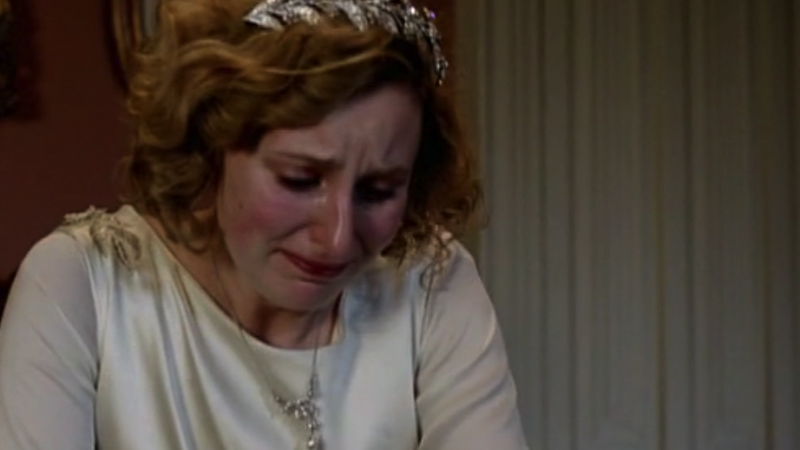
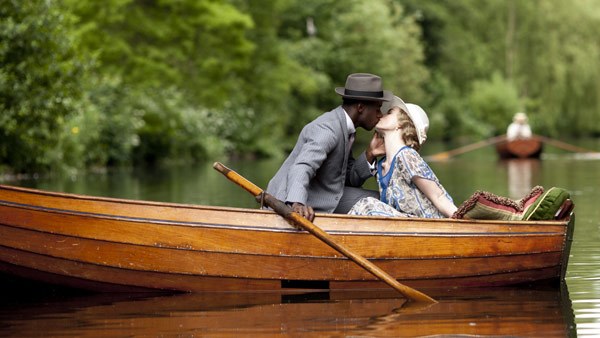
I was in need of comfort a couple of weeks ago, so I binged Downton Abbey.
And despite its complicated relationship with all the -isms, it was comforting.
However, I have some thoughts.
Edith is stupid and whiny. I just can’t with her. I try to sympathize; I really do, but her constant unhappiness is usually her own damn fault. We’re supposed to contrast her to her “selfish” sister, Mary, but Edith is far more selfish. She should have considered that she would have been hurting her whole family when she ratted Mary out. She shouldn’t kiss married farmers. She shouldn’t take a baby away FROM TWO DIFFERENT MOTHERS WHO LOVE HER. She shouldn’t ruin the Drewes’ marriage or make that family have to leave the land they’ve been on “since Waterloo.” And after doing all of that, she shouldn’t have still been complaining at the end because she doesn’t get to do whatever the fuck she wants. None of us do, dear.
2. Marigold is too big. In way too many scenes, she looks older than her cousins.
I’m never happy, and I give birth to giant babies.
3. I can’t tell George and Tony apart. I was frustrated when I first watched this, but I thought I would do better the second time through. Nope. When Mary talks to one of them, I have to hope that she’ll say his name or that someone will bring up pigs.
4. The most disturbing image in the show is Rose’s clavicle. How can any of these men want to kiss her when her skeleton is trying to leap out of her body?
The only possible way this is okay is if her clavicle pops a boner when she’s aroused.
5. The show does well in exploring both overt sexism and emotional labor expectations. As I often explain to my students, shows made now but set in the past represent our values. We are to love Carson (he reminds me so much of my (grand)Daddy), but we are to side with the women and the lower class characters who want more equality of opportunity. There are many overt examples, but on this rewatch, I was drawn to all the moments in which the show focused on protecting men’s feelings, on coddling them, on keeping things from them because they couldn’t deal with them.
A lot of this is seen with Carson, in fact. His wife can’t tell him he’s being a sexist asshole when he demands a second shift from her at home. She and Mrs. Patmore have to trick him into seeing how difficult that shift is instead.
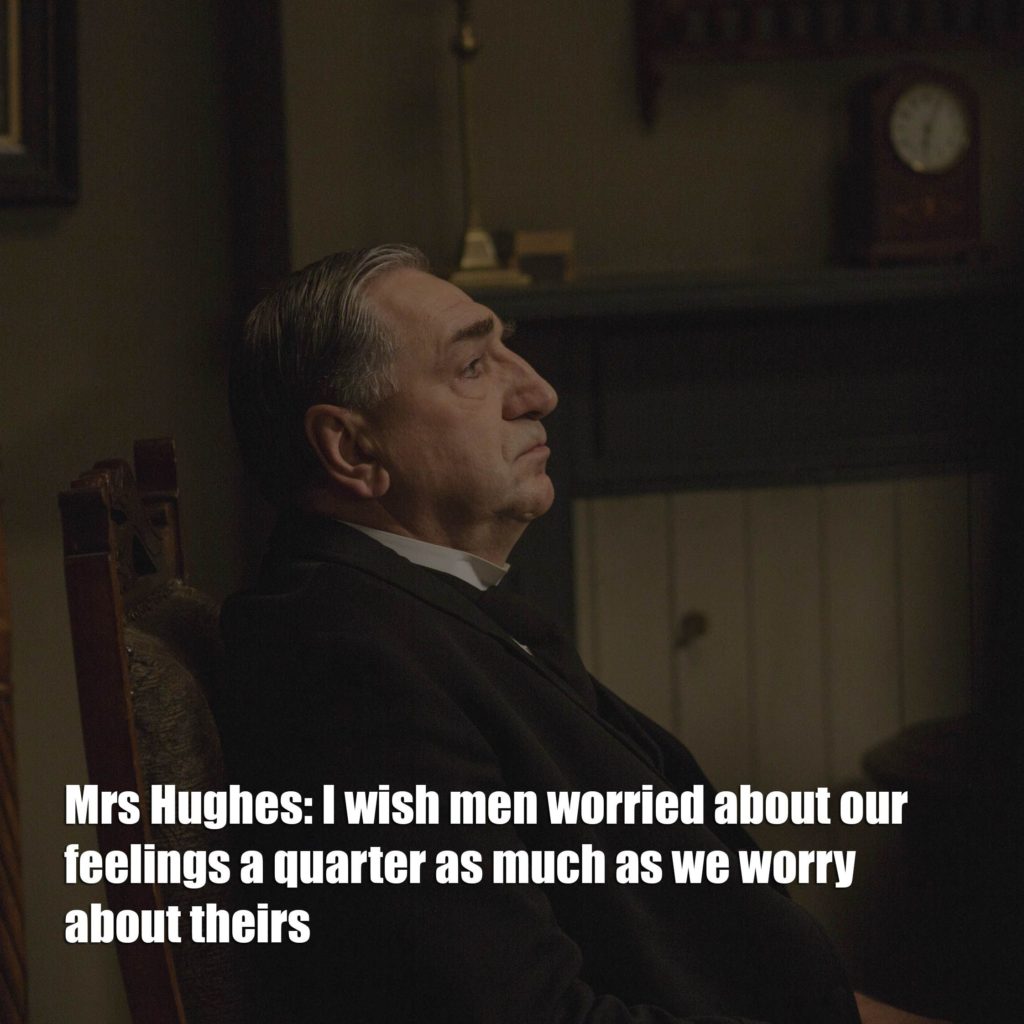
Just like they have to strategize about how to break the news to him that Mrs. Patmore won’t be taking his financial advice. Mrs. Hughes sums it up perfectly: “I wish men worried about our feelings a quarter as much as we worry about theirs.”
My reluctance to marry, to live with someone, to even date right now, is largely predicated on this bullshit male behavior, since every man I’ve lived with has expected me to be a maid of all work while working more than full time, while also being the household therapist, personal assistant, fluffer, etc.
6. As much as I might fantasize about being Violet Crawley when I’m older, I’m going to be Martha Levinson. She isn’t pretentious, she turns down unsuitable suitors, and she enjoys a good meal, unapologetically.
7. Whatever happened to Michael Gregson’s wife? The whole point of him going to Germany was to be able to divorce her. He says several times that his wife, away in an asylum, doesn’t recognize him. Even if we take him at his word, I want to know what happened to her once he died. He left everything to Edith. So who’s paying for the asylum? Who’s making sure this woman is safe?
Edith, of course, never considers her for a second. Because, as noted above, she’s a selfish cunt.
8. Mary should have killed Mr. Green. It would have been so simple. Wait for him to come to Downton. Beat him, stab him, or shoot him. Explain to the police that he tried to rape an upper class woman. The end.
On Monday, in preparation for an endoscopy, I have a Covid test. It didn’t hurt, exactly. Instead, my body was hyper-aware that something was in a place it should not be. Thus, my body tensed up and freaked out. My eyes watered cause my sinuses were irritated–and I felt weird for a few hours.
But the test came back negative.
So I was cleared for yesterday’s procedure.
I have severe GERD, exacerbated by a hernia. I have bile reflux too. These problems, combined with a family history of esophageal cancer, mean we need to check me every few years.
The severe GERD meant they had to fully sedate me–they wanted to intubate. That meant, unfortunately, that everyone else in line for the procedure got to go first. It was a fasting test, so I just lay there, getting hungrier and thirstier for a few hours.
When they finally took me back, my IV line got jerked around a lot. My arm is still in bad shape. Also, who IVs on the TOP of the hand? The dominant hand?
I woke up with a sore throat, naturally, and got dressed. When I looked down at the hospital bed, I saw a wet spot. There was no smell or color, but my panties were a bit wet too.
Thus, like all classy ladies, I threw them in my bag and tried not to Sharon Stone anyone when I was getting wheeled out to the car.
Today, I’m wiped out, and my throat is still killing me. And it hurts to type, so I’m going to stop and take the rest of the day fully off.
In the last week, Fox News has been having problems being, well, news.
This Rolling Stone article details several problems, with Fox using images from one city in a story about another and outright altering images to make police look innocent and to make the Seattle protest look scary.
Some of their errors are unintentional, however.
Last Friday, a reporter quoted Reddit, saying the post showed divisions in the Seattle protest.
Except it was a joke.
From Monty Python and the Holy Grail.
In Karlissa’s new book on source use, we have a section about how satire news gets mistaken for real news sometimes.
But we didn’t think a “news” source would fall for such obvious satire.
We would, however, believe it if they called us all “bloody peasants” behind our back while they misrepresented our desire for an anarcho-syndicalist commune. We’re also fairly certain they would totally make Trump king for life on the word of some moistened bint.
[Update: I don’t want to have a whole new post every time Fox alters data, so I’m just going to add examples here.]
Fox News cut Donald Trump out of an infamous picture of Jeffrey Epstein (with their significant others).
This is the one week until December that I won’t be teaching. It’s the first such week of the year.
The first three weeks of my first session summer class are loaded onto Canvas. The handouts and activities have been adapted for optimal online learning.
The cat videos are loaded into the weekly wrap-up pages.
But I can’t just rest this week. There’s admin work to do, three medical appointments, including an endoscopy, trying to get my fence cat-proofed because one neighbor doesn’t like Thoth, . . .
Still, I am committed to only working half-days.
My problem, though, is how bad I am at relaxing. My workaholism has a big list of things for me to do. Even when I can convince it to let me read or watch tv, it has certain ideas.
“You should watch the foreign films in your DVR, since you usually can’t give yourself time to focus on what you’re watching.”
“You need to catch up on your New Yorkers. Do one a day while you can.”
“You should watch at least one stand-up special a day, even if you’re not in the mood, for research.”
I feel weird when I’m not working or crossing something off a list.
It’s pathological, and over the years I’ve gotten better at fighting it, but I still have to remind myself that I’m not doing anything wrong if I’m not being productive, that I don’t need to justify tv time by doing the most difficult physical therapy exercises while I watch.
This last quarter, I was by necessity glued to my computer–and I will be again next week.
I decided to take Sundays off from school work.
The boy says he thinks it’s doing me good, so I’m going to keep trying.
It seems like every week, a flurry of articles comes out about something The Simpsons has predicted.
I’ve written about this several times, most recently in this blog.
Right now, fake news is going around about The Simpsons predicting the murder of George Floyd.
They didn’t.
The images that are being used to argue it don’t come from the show–someone has altered them.
One picture was created intentionally as a form of social protest.
I am terribly irritated at “news” sources, though, that repeat the debunked rumors.
Take this article, for example, from something called Lastly.com.
It looks vaguely like a news source, enough to fool some people. I couldn’t find an “about us,” etc.
After repeating the rumor, the article showed the pictures used to further it.
At the end, the author clarified his/her ignorance: “it was not immediately clear as to which episode from The Simpsons aired the White House lights off. Or if at all, the pics belong from [sic] the cartoon series.”
The passive voice is deceptive.
It actually is clear–to anyone who either knows the show or who does the most basic research of asking someone who knows the show.
If “news” sites like this did any kind of fact checking, this rumor would not have spread so far. Snopes actually had to address it.
(In case you don’t trust me, trust Snopes. The rumor’s false.)
My mother said that Obama was going to take away our rights as white women.
My grandparents wanted a garden, to grow vegetables, to survive the race war Obama was going to start.
Except he didn’t.
He didn’t violate the Constitution. He didn’t take away their guns.
In fact, his attempts to work with the party that (in many cases literally) demonized him frustrated us.
We knew there was no way to work with people who called him a racist for empathizing with Trayvon Martin’s parents.
We are at a crisis point, one that’s long in coming. The same party that told us racism was over is also full of White Supremacists–racists that the party and its leader won’t disavow.
That same President then tear-gassed peaceful protesters this week and has incited lethal violence against them.
I’m watching white people bend themselves into ridiculous positions to write off the BLM movement.
Luckily for them, they’re very limber from all of the practice:
They believe that you can never question the police and somehow that there isn’t a single violent racist one.
If an unarmed black (or brown or “red”) person dies, it’s okay because that person broke the law once when they were a teenager.
If that person dies, it’s because they didn’t follow instructions nicely or fast enough.
Even if the did, it’s still okay if they died, because any time an officer is scared for a second, he gets to kill someone.
We aren’t allowed to have self-defense in these cases. No one can raise their hands to shield themselves or to try to run away or to say they can’t breathe. Any attempt to not to be murdered by the cop will be seen as exactly why the cop gets to kill the person.
After the murder, no one gets to protest.
If they do, they hate America and all cops and veterans and Jesus.
If they do, the Vice President will use tax payer dollars to protest them protesting.
If they do, the President will say they should lose their jobs.
However they choose to protest will be the wrong way.
If there’s even one violent protester, white people get to dismiss the entire movement.







Recent Comments