What Would Margaret Atwood Do?

Politics and other nonsense, Words, words, words

It’s been a difficult week here in pre-Gilead.

And it’s only Thursday morning.

I’m tempted to stop watching and reading the news. And I understand why many friends have.

But I’m an Atwoodian.

So when it occurred to me that I should take a “break” from reality for my mental health, a little voice said, “careful, June.”

June/Offred, in The Handmaid’s Tale, was passive, like so many of us are. She was lulled into accepting roadblocks as necessary after a terrorist attack–they became normal. And when the government started attacking women’s rights, she didn’t go to the marches–she tried to distract herself with baking, with her daughter’s lunches. And then they started opening fire on the protestors.

She tried to act too late.

“We lived, as usual, by ignoring. Ignoring isn’t the same as ignorance, you have to work at it. Nothing changes instantaneously: in a gradually heating bathtub you’d be boiled to death before you knew it” (74).

Jimmy/Snowman, in Oryx and Crake, is the same, except as a male, he is more protected. He is privileged enough to be obtuse, to not ask, when his friend says sterilizing people without their knowledge is “step one”: “Wait, what’s step 2? And where do these steps lead?”

And then it’s too late.

“How could I have missed it? Snowman thinks. What he was telling me. How could I have been so stupid? No, not stupid. He can’t describe himself, the way he’d been. Not unmarked–events had marked him, he’d had his own scars, his dark emotions. Ignorant, perhaps. Unformed, inchoate. There had been something willed about it though, his ignorance. Or not willed, exactly: structured. He’d grown up in walled spaces, and then he had become one. He had shut things out” (184).

I can’t choose what these narrators do.

I can’t turn off the news and start a loaf of bread. I can’t be lulled by pizza and sex.

My eyes have to stay open, even with the tears.

My voice has to stay loud, even though I’m hoarse.

My heart has to keep beating to fuel this fight, even though I’m weary.

Atwood has written the warning.

I must heed the call.

Share
0 comments

London by the Numbers (2018)

Travel

shortest amount of sleep in one night: 3 hrs

longest amount of sleep in one night: 15 hours

Michelin restaurants: 1 (but twice)

Nandos: 1

museums: 8

plays: 4

books read: 2

New Yorkers read: 2

London wineries (Renegade) visited: 1

tapas style dinners: 6 (2 Indian places, 1 Malaysian, 1 Spanish, 1 Greek)

ideas for a British porno: 1 (“Alas, Poor Fanny”)

times Karlissa decided it was easier and safer to take a cab instead of trying to find the nearest tube stop, due to lateness of night and amount of wine consumed: 1

drinks in ancient church crypts: 1

detailed descriptions of ripping urethras: 2

Indian desserts made from carrots and peanuts: 1

Lebanese wines: 1

Lebanese beers: 1

Servings of duck: 4

Summer blackberries consumed: 0

Sadness about lack of summer blackberries: endless

Toffee yogurts: 2

Songs played by the St. Martin’s in the field orchestra for the few moments we popped in before a show: 3

Times we should not have trusted the waitress when she said the portions were small: 1

Times an asshole cut in line in a cafe after saying he was late for yoga, but then asking that his croissant be toasted: 1

Indian-spiced fried okra servings: 2

one of the best plays of our lives: 1

one of the worst plays of our lives: 1

bottles of wine at the first wine bar in London: 2

dresses observed made from pineapple leaves: 2

music videos I made people watch by Ninja Sex Party: 2

times we almost fell in the bathroom due to a weird, poorly located step: 7

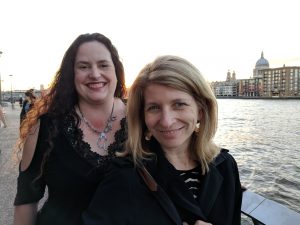
10 at night on the Thames

Share
0 comments

Finally: A Raise

Teaching

I just got a raise.

It’s a long story, though.

Every three years, I come up for review. As a union member, if I’m rehired, I get a 6% raise every three years–this is dependent on my being “excellent.”

In Fall 2015, I put together a review packet and asked for a merit raise of 3% in addition to the regular one. Why? Well, research faculty get raises for publications, for editing journals, for presentations, etc. I am the author of several books and articles. I edit a peer-reviewed journal. Etc. All but one of the tenured faculty in my department supported that request, which was then forwarded to the decision makers.

In Spring of 2016, I was nominated for and received a teaching award.

A few weeks later, UC Davis told me that I could not get a merit award–that it was great that I do all this research and publishing, but that I can’t ever get a raise for it, since I’m teaching faculty instead of research faculty. (Research faculty (aka tenure track), by the way, are the ones who get to vote on things like my raises.) In other words, they said since publishing wasn’t part of my job–something I’m already paid to do–I can’t get a raise for it, like they can. (I don’t think they understand what raises are for.)

They said that the only way I could get a raise was to win a teaching award or to publish a textbook. They mentioned that since my teaching was amazing, I would likely get a teaching award soon.

I appealed, noting that in between asking and being denied, I had in fact won that award. I also noted that since they could tell I deserved one, I should have gotten a raise anyway–they were looking at the same materials the award committee was, after all.

And you can only win that award once. And only two are granted a year, so that means a bunch of amazing teachers won’t ever get the raises they deserve.

In my appeal, I also made the argument that if the only part of my job that counted was my teaching, I should get a raise for serving on a dissertation committee and for teaching independent study classes. Both are teaching. Both are unpaid labor. In fact, when I teach independent studies, the university gets paid by the student, but I don’t get paid at all.

I swayed half of the committee to reevaluate. The dean broke the tie, denying the merit raise.

Three more years have come and gone. In that time, I have done even more professional development, I have attended more conferences, given more interviews, published more articles and books, taught more “free” classes, done more admin work (paid and unpaid), etc.

And one of those publications was the textbook I authored with Melissa.

Within the last three years, someone who won the teaching award after me has gotten her raise.

Melissa has gotten a raise for our book.

So this fall, when I turned in my packet, I argued that I should get the union 6%, 3% for the 2015 teaching award, and 3% for the textbook.

About half of the tenured faculty in my department agreed. The other half said I should just get 3% (like Melissa did, which would have negated my teaching award entirely).

One faculty member, the one who said I didn’t deserve merit last time, wrote a red herring argument about how she hated one small piece of my admin work, which went into the file.

So I was worried.

Today, however, I learned that I got my 12%. By one vote.

Share
1 comment

Karma Reads Books: Beowulf by Garcia and Rubin

Misc–karmic mistakes?, Words, words, words

Two Waltonens agree: meh.

We both wanted to like this book: we’re graphic novel fans, and there are some interesting things happening with the art here . . .

But meh.

Beowulf isn’t a great story–it’s old, and it was originally poetic, but this version replaces the poetry with images, and they just aren’t interesting enough to make the story compelling.

The authors also make a weird choice.

I won’t spoil it, but I will say I had to go back to figure out if I was seeing what I thought I was seeing. There is an art choice that changes a dynamic in a fundamental way–but then it is NEVER explained or addressed. Thus, it’s just confusing. It’s also an image I would like to get out of my mind.

Share
0 comments

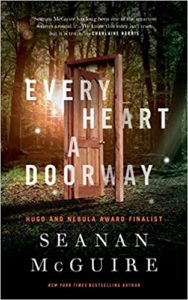
Karma Reads Books: Every Heart a Doorway

Words, words, words

I have been passing around Seanan McGuire’s Every Heart a Doorway for a month now.

It’s a lovely little book and a very quick read.

The premise makes the book sound more juvenile than it is–you know all those old tales of children disappearing into fairy realms–and how they sometimes come back?

In this book, that happens. And then parents don’t understand–don’t believe their children. Surely their children were abducted–surely they’re repressing something.

And so many of those children wind up at a boarding school, run by another who has returned.

This story is dark in all the right ways–with longing and loss and death.

Like all good fantasies, it poses moral questions about our own world–what do we do with those who don’t fit in? Why don’t we believe our children when they tell us who they really are–that they’re asexual, that our little “girl” is actually a boy, that they long for something we can never give?

Share
0 comments

Karma Reads Books: Etched in Bone by Anne Bishop

Words, words, words

Last night, instead of sleeping, I finished Etched in Bone by Anne Bishop, the fifth book in The Others series.

My friend April first turned me on to it–it’s urban fantasy (fantastical creatures, but in our time instead of a medieval time).

This is an alternate version of our world, one in which the great spirits and creatures (vampires, werewolves, etc.) and humans exist, knowing about each other. The landmass that we call America was “discovered” by humans, and the humans made pacts with the powers that were there–sometimes trading goods for permission to live and to expand.

Except now the humans have forgotten how powerful the Others are and think they can break the compacts that have kept them from being prey.

Many fantasy stories have naive protagonists so that we can discover how the world works the same time they do.

Our protagonist is Meg–not quite human, not quite other. She is a prophet–like others of her kind, she has been caged and abused.

The first book opens with her running away and finding shelter at Lakeside–a unique community wherein Others and Humans try to coexist in the same space (the Others want to study us).

There’s a lot going on in this series–The Humans First and Last Movement sound and act a lot like our alt-right. And while the Others might both be read as Native Americans (with the power and inclination for revenge for what we stole), there are communities of intuits who resemble our idea of the spiritual Native American. There are issues of equality, power, community vs. the individual, the problems of mating, etc. The book also doesn’t shy away from the reality that human men abuse others (especially women) all the time. Reading the “savage” “animal” others judge us for our sins is necessary and sometimes difficult.

One of the things I appreciate about this series is something others might not–it’s a lot about how we make things work–how do we distribute resources equally? How many chances should a trouble maker give? When do you take a child away from a parent for its own good? How can you make a sad coworker feel better. There are a lot of conversations, misunderstandings, meetings–the things that usually don’t make for good fiction, but that add a wonderful layer of realism here.

Share
0 comments

The Continuing Adventures of OnLine Dating: 81

dating

A guy wrote:

“Hello, my name is [redacted] I’m attempting to introduce myself to you. I must say it’s one of the most awkward things I’ve ever tried. I mean how does a man say hello and convey his interest in a woman on POF of all places and not sound like some player, Viking or some other undesirable. I’d like to tell you how beautiful but not have it sound like some sort of one liner. What I seek is companionship and a partnership I don’t seek to date numerous woman or have meaningless relationship’s. Im mature, fun and laid back if I sound like someone you’d like to get to know message me back.hope.to hear from you.”

POF=Plenty of Fish

He messaged me on OKCupid.

If one is trying to avoid having things sound like one-liners, one should avoid obviously cutting and pasting one’s opening gambit.

Share
0 comments

This Recognition Put a Spring in My Step

Teaching

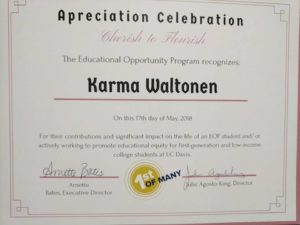
At UC Davis, I do a lot of work with our EOP/STEP programs, for students who are first generation and economically disadvantaged, including giving talks for the program and teaching a specialty developmental writing course.

I do this because I was like them.

I tell them my story and how the most crucial thing I learned was to ask for help.

I show them that people like them can move up in the world through education, even though the climb is so much steeper.

Some years, the program thanks me. This was one of those years.

On the back, a note from the nominator:
“I would have never thought that my favorite class at UC Davis would be Workload 57P. I was able to learn in greater detail the fundamental rules of writing. In this course, I learned more than in my four years of high school English combined. This wouldn’t have been possible without Dr. Karma Waltonen’s amazing work ethic. Dr. Karma Waltonen truly believes in the success of her students and their true potentials. She understood our struggle coming from nontraditional backgrounds, so she made sure to secure a welcoming environment. What I found most helpful and inspirational were the stories of the obstacles she has faced in life. Many of us, if not all, were able to relate to it one way or another, which tore down the wall of silence in the classroom. She made me want to be a better student for her, my parents, my siblings, and the generation to come. The other nice thing about this course was that I was able to see familiar faces from STEP, removing the feeling of loneliness and giving me the opportunity to challenge my writing ability without the fear of being judged based on my appearance.”

Share
0 comments

Marjorie Prime at CapStage (Review)

Movies & Television & Theatre, Words, words, words

I loved Marjorie Prime.

I went into it as a blank slate, and it’s probably best if you do the same, so this review with be brief and with as few spoilers as possible.

Marjorie Prime was written by Jordan Harrison, and is directed here in a co-production with American Stage by Stephanie Gularte.

It’s a brief, powerful play with wonderful acting and a gorgeous set.

In an attempt to avoid plot, let me pose some questions:

If you could interact with someone you lost, what age would they be?

If you could change your memories, what would you rewrite? What would you forget completely?

What if Alexa were programmed to be your grief counselor?

Do you want to see a play you’ll be thinking about for weeks?

Marjorie Prime runs through June 3rd at CapStage.

Go see it.

Share
0 comments

Fun Facts About Museums

Museum Musings

Happy International Museum Day!

Did you know….?

The first museum curator was a woman. Princess Ennigaldi, daughter of the last king of the Neo-Babylonian empire, established what is believed to be the first museum, around 530 BCE, in what is now Iraq. Some of the artifacts that the princess organized in the museum date back to the 20th century BCE and have labels (carved into clay cylinders)–in three languages.

The first tyrannosaurus rex fossil ever unearthed (in Montana in 1902) has resided in Pittsburgh’s Carnegie Museum of Natural History since 1941, but it was only in 2011 that it was reunited with one of its rib bones, accidentally left behind when it moved to Pittsburgh from its previous home at the American Museum of Natural History in New York City. A researcher found the rib in the museum’s “spare bones box” and then a curator brought the rib to Pittsburgh–in his backpack!

Iceland’s Phallology museum contains more than 200 mammal penises, including one human penis and one elf penis (pictures are not allowed–you’ll have to go for yourself).

The Mona Lisa was stolen from the Louvre in 1911 and not recovered for over two years. An Italian handyman working at the museum took the painting from the wall, slipped it under his cloak, and walked out. Motivation for the crime? He was under the false impression that Napoleon had stolen the painting when he conquered Italy and thought he was righting that wrong by taking it back to Italy. In fact, it was Leonardo Da Vinci himself who had brought his now famous smiling lady to Paris.

850 million people visit U.S. museums annually, far exceeding the 140 million who attend a major-league sports event each year.

Want to learn more? Then follow Karlissa’s new blog, Museum Musings, here at dr-karma.com.

Karlissa, talking about museums.

Share
0 comments