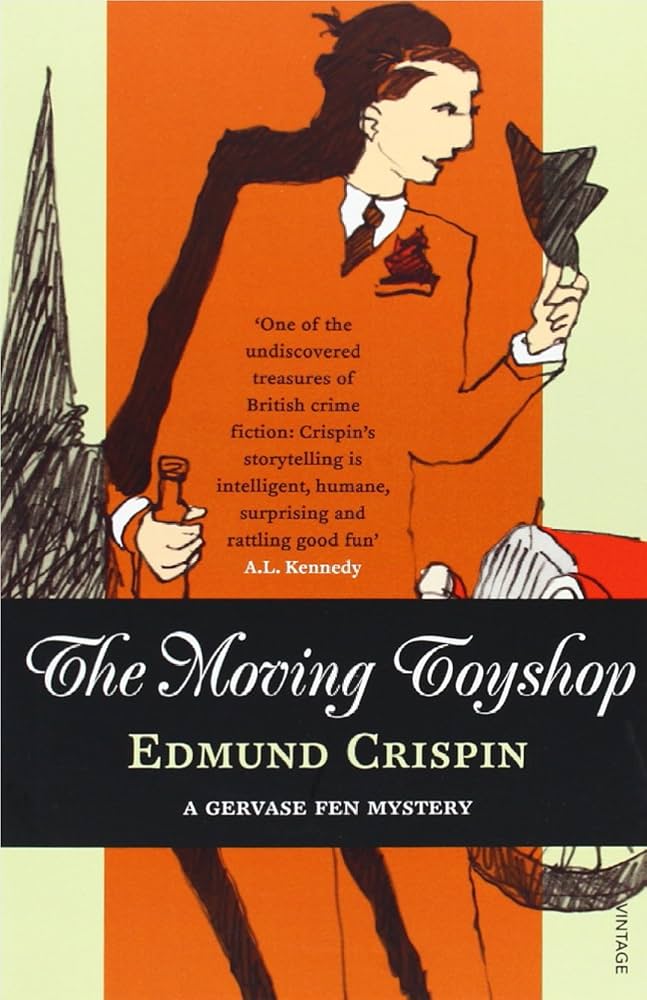
When sick in Oxford on a rainy day, what’s an American to do but cuddle up with a cuppa and read a book set in Oxford?
I started The Moving Toyshop, by Edmund Crispin (1946). The series features an Oxford literature professor as the detective and lines like the ones below, so I thought I would love it:
“I am getting old and stale. I act with calculation. I take heed for the morrow. This morning I caught myself paying a bill as soon as it came in. This must all be stopped. In another age I should have devoured the living hearts of children to bring back my lost youth. As it is . . . I shall go to Oxford.”
“Oxford is the one place in Europe where a man can do anything, however eccentric, and arouse no interest or emotion at all.”
But then there was the first look at the murder victim:
“There was no ring on her left hand, and the flatness of her breasts had already suggested that she was unmarried.”
Later, we’re told that a picture of the victim is surprising: “it was not the face of an ineffectual spinster.”
In these instances, my brain threw up defenses: “hey, we’re not all . . .”
What’s weird here isn’t so much that a 1946 novel written by a man was sexist.
I’ve been married and divorced, and I’m married now. I’ve been a mother every single second I’ve been an adult.
What’s weird is that I’m not a spinster, but my brain decidedly thinks I am. It’s always had a “we” response to statements about us . . . I mean, them . . . ever since I was a little girl.
I guess I was always a black sheep enough to know that I was destined to be the maiden aunt, well, not the maiden aunt, but the eccentric aunt who was a “bad” influence on the children.